
Every click in PPC has a cost, so spending your budget without understanding the competition can quickly become expensive. Looking at what other advertisers are doing gives you a clearer view of the market and helps you make decisions based on real patterns.
Instead of guessing what works, you can learn from what is already happening in your market. PPC competitor analysis helps you look at competitors’ keywords, ads, offers, and landing pages. You can find useful insights. You can also spot missed opportunities.
The real value comes from turning those observations into action. You can find helpful keywords. You can improve your offers. You can sharpen your messaging. You can also create landing pages for a better customer experience.
What Is PPC Competitor Analysis?
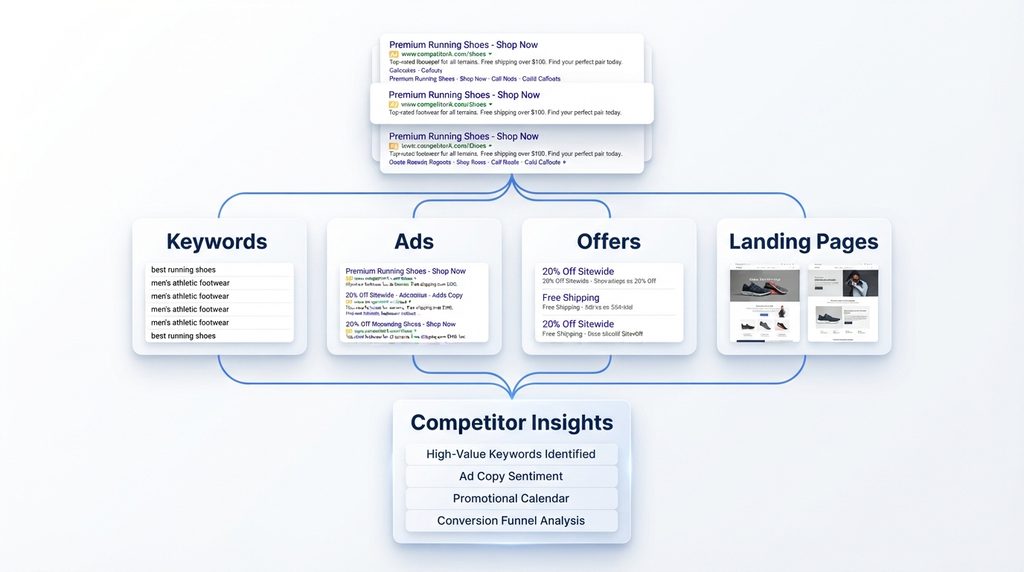
PPC competitor analysis is the procedure of researching businesses that compete with you in paid search. You look at the keywords they target, the ads they show, the offers they promote, and the landing pages they use.
For instance, imagine you sell running shoes online. You search for “buy running shoes” and notice several businesses appearing in the paid results. One offers free shipping, another focuses on lightweight shoes, and another highlights a discount. These details give you clues about what competitors believe will attract most of the shoppers.
The research can also reveal things that are missing. Perhaps none of the ads mention a long return period, even though your store offers one. That could become a useful selling point in your campaign.
Why PPC Competitor Analysis Matters
Good research can help you understand the market before you spend more money on advertising. You can learn from how other businesses position their ads. This way, you can find ways to stand out instead of just guessing.
It can also help you find useful keywords, improve your messaging, strengthen your offers, and create better landing pages. Most importantly, it gives you a clearer picture of the customer journey from search to click to conversion.
Get Ahead of Your PPC Competition
Discover competitor gaps and turn them into smarter opportunities for your PPC campaigns.
Analyze Your Competition TodayBasic Steps to Conduct an Effective Competitive PPC Analysis
A useful competitive review does not need to be complicated. You can follow a simple process and gradually build a clearer picture of the market. The six steps below take you from finding competitors to using what you learn.
Step 1: Identify Your PPC Competitors
Search for the main keywords that matter to your business. Look at the paid ads that appear and note which companies show up repeatedly. These businesses may be your PPC competitors, even if you do not consider them your biggest traditional competitors.
It helps to search several types of terms. Try broad product or service searches, location-based searches, and high-intent phrases such as “buy,” “hire,” “near me,” or “best.” You can also use PPC research tools to discover advertisers that may not appear every time you search manually.
Do not create a huge list just for the sake of having one. Focus on competitors that repeatedly target keywords and audiences that matter to your business. This keeps your research focused and useful, helping you feel more in control of your strategy.
Step 2: Analyze Their Target Keywords
Once you know who your competitors are, look at the keywords connected to their paid campaigns. The goal is not to target every keyword they use. Instead, look for patterns and opportunities.
For example, a competitor may focus heavily on broad terms while ignoring more specific searches. If you sell accounting software, they might pick “accounting software.” They may miss “software for small businesses.” That more specific phrase could attract people with a clearer need.
Pay attention to search intent, too. A person searching “what is accounting software” is just starting. A person looking for “accounting software pricing” is further along. Understanding this difference can help you spend your budget where it has a better chance of producing useful actions.
Step 3: Review Their Ad Copy and Offers
Look beyond the headline and ask why someone might click. Are they promising lower prices, free delivery, expert help, faster service or any special feature?
Notice repeated ideas. If several businesses mention the same benefit, customers may care about it. However, repeating the same message will not necessarily make your ad stand out.
Seek to express your worth more clearly. If competitors focus on discounts, perhaps you can highlight quality or support. If they promise speed, you might offer a stronger guarantee. Your offer should be honest and genuinely useful to the customer.
Step 4: Evaluate Their Landing Pages
An attractive ad can earn a click easily, but the landing page has to continue the conversation. Open your competitors’ landing pages and see whether the page delivers what the ad promised.
Look at the headline first and analyze these points mentioned below:
Does it match the search and ad?
Is the main benefit easy to understand?
Can visitors quickly see what they should do next?
Also, think about the page experience. A cluttered page, confusing form, slow loading time, or unclear CTA can drive visitors away. On the other hand, a simple page with useful information, strong trust signals, and an obvious next step can make the journey easier.
This is an area where you may find valuable opportunities. If competing pages make customers work too hard to find answers, a clearer page could give your campaign an advantage.
Step 5: Identify Competitive Gaps and Opportunities
Now bring your findings together. Look for areas where competitors are weak, inconsistent, or missing something important. These gaps can become opportunities for your campaigns.
You might discover that competitors do not address a specific customer group. Maybe their ads use generic language, while your business has a service designed for a particular audience. Or perhaps their landing pages explain features but do not clearly explain the benefits.
Make a simple list of the strongest opportunities you find:
- Keywords competitors overlook
- Customer needs that their ads do not address
- Benefits they fail to explain clearly
- Weak offers or calls to action
- Landing-page problems you can improve
The best opportunities are not always the most obvious ones. Sometimes a small improvement in relevance or clarity can make a meaningful difference.
Step 6: Apply Your Findings and Monitor Performance

Research only becomes valuable when you use it right. Take the strongest insights and apply them to your own campaigns. Test, improve ad copy, adjust offers, add new keywords, or create a more relevant landing page. For remodeling businesses, Remodeler PPC Services help create targeted campaigns. These campaigns reach homeowners who are ready to act.
Do not change everything at once. If you make too many changes together, it becomes difficult to know which one helped. Instead, test important changes and compare the results with your existing performance.
Competitor research should also continue over time. Businesses change their offers, ads, keywords, and landing pages. A campaign that looks different six months from now may give you new information about where the market is heading.
How to Outperform Your PPC Competitors
Knowing what competitors do is only half the job. The bigger question is how you can use that information to create a stronger campaign. Winning does not always mean having the biggest budget. Relevance, clear messaging, and a better customer experience can also make a major difference.
Create More Relevant and Compelling Ads
Your ad should quickly answer the question, “Why should I click this?” Match the message to what the person searched for and highlight a benefit that matters to them.
For example, an ad for emergency plumbing should not spend most of its space talking about the company’s history. A customer with a leaking pipe likely wants fast help. A clear message about quick response times may be much more useful.
Strengthen Your Unique Value Proposition
Your unique value proposition explains what makes your business worth choosing. It could be a useful feature, flexible options, expert services or a better customer experience.
Look at your competitors, but do not let them decide your entire message. If every business in your market says the same thing, finding a genuine point of difference can help your ad become more memorable.
Build Better Landing Pages
Make sure the page matches the promise made in the ad and gives visitors the information they need.
Keep the main action obvious and use clear headings, helpful content, trust signals, and a simple path to conversion. If your ad promises a discount, visitors should not have to search through several pages to find it.
Focus on High-Intent Keywords
A keyword that brings thousands of visitors can be less valuable than a smaller keyword that attracts people ready to take action.
Study the intent behind your keywords and prioritize searches that fit your product or service. This can help you avoid wasting money on clicks from people who are unlikely to become customers.
Test and Optimize Your PPC Campaigns
PPC works best when you treat it as an ongoing process. Test different keywords, descriptions, headlines, landing pages, offers and calls to action.
Watch the results and keep the changes that improve performance. If an idea does not work, learn from it and try something else. Even small improvements can add up when you optimize consistently.
Build a PPC Strategy That Stands Out
Improve your keywords, ads, and landing pages to attract more valuable clicks.
Start Optimizing Your PPC CampaignCommon PPC Competitor Analysis Mistakes to Avoid
Competitive research is useful. However, it can mislead you. Don’t treat every competitor’s action as a proven strategy.
Copying Competitors Instead of Learning from Them
A competitor’s ad may look successful, but you cannot know its full results just by seeing it. Copying their wording or offer may also make your business look like everyone else.
Use competitors as sources of information, not templates.
Focusing Only on Ad Copy
Google Ads are important, but they are only one part of a PPC campaign. Keywords, search intent, landing pages, offers, targeting, and user experience all influence performance.
Ignoring Your Own Campaign Data
Your competitors can show you possibilities, but your own data tells you what is actually working for your business. Use both sources of information when making decisions.
Competing Only on Price
Lowering your price may attract attention, but it can also reduce profit and start a race that is difficult to win. Look for other ways to create value, such as convenience, expertise, quality, service, or a stronger guarantee.
How to Measure Your PPC Competitive Performance

After making the required improvements, track the numbers that matter the most. Click-through rate shows if your ads grab attention. Conversion rate tells you how well those clicks lead to desired actions.
Cost per click and cost per conversion help you understand how efficiently you are spending. Return on ad spend can show whether the revenue generated by advertising justifies the investment. Impression share can also help you understand how visible your ads are compared with other advertisers.
Do not judge success by the number of clicks alone. A campaign that gets fewer clicks can still do better. If it brings in more qualified leads or sales, it’s more effective than one with many clicks but few qualified leads. Your final goal should always connect PPC performance to real business results.
Final Thoughts on PPC Competitor Analysis
Strong PPC campaigns are built with more than a good ad and a large budget. You need to understand what customers want, what competitors are offering, and where you can provide something better.
PPC competitor analysis gives you a practical way to uncover those opportunities. Study the market, identify useful gaps, improve your ads and landing pages, and test your ideas with real data.
Most importantly, keep learning. Competitors will change, customer needs will shift, and new opportunities will appear.
Ready to Make Your PPC Budget Work Harder
Get expert PPC support to uncover opportunities, improve performance, and drive better results.
Take Your PPC Campaign FurtherFrequently Asked Questions
PPC competitor analysis is the process of studying other businesses that advertise for the same or similar keywords. You can review their ads, keywords, offers, landing pages, and messaging to understand how they attract customers and where you can compete more effectively.
PPC competitor analysis helps you understand what other advertisers are doing before you spend more money on your campaigns. It can reveal useful keywords, common offers, messaging trends, and weaknesses you can improve on. This allows you to make smarter decisions instead of relying only on guesswork.
Start by searching Google for the main keywords related to your products or services. Note the businesses that regularly appear in the paid results. You can also use PPC research tools to identify advertisers, keywords, and competitive trends that may not be obvious from manual searches.
Look at their headlines, descriptions, offers, calls to action, and benefits. Pay attention to repeated messages and the reasons their ads might attract clicks. Then compare those elements with your own ads and look for ways to make your message clearer, more relevant, or more useful.
You can discover competitor keywords by using PPC research and keyword intelligence tools that provide information about paid search activity. You can also search important industry terms manually and record which competitors appear. Focus on keywords that match your audience and search intent rather than trying to copy every keyword.
Popular options include Semrush, Ahrefs, SpyFu, and Similarweb. These tools can help you research competitor keywords, paid search activity, ad copy, and other competitive insights. The best tool depends on your budget, campaign size, and the type of information you need.
It can help you identify better keyword opportunities, understand customer intent, improve your ad messaging, and strengthen your landing pages. Competitor research may also reveal gaps in the market that you can use to create a more relevant offer or position your business differently.
Compare several competitors across their keywords, ads, offers, landing pages, and calls to action. Look for customer needs they do not address, valuable keywords they overlook, weak offers, or landing pages that make it difficult to take action. These gaps can become opportunities for your own campaigns.
No. Competitor ads should provide insights, not templates. Copying their wording can make your business look like everyone else and may not produce the same results. Instead, identify what works in their approach and use those ideas to create original messaging based on your own strengths and customers.
A thorough analysis every three to six months is a good starting point for many businesses. You should also keep an eye on competitors throughout the year, especially when you notice major changes in their ads, offers, keywords, or landing pages. Regular monitoring helps you respond to changes before they affect your campaign performance.