
CEO, American Design Hub
I’ll be honest.
After more than 10 years of helping businesses build websites and digital products, one thing still catches owners off guard when I say it out loud. You’re not struggling to pick an agency because there aren’t enough options. You’re struggling because every single one of them sounds identical.
Visit ten agency websites right now. I’ll bet you find some version of the same three lines on all of them.
“We’re customer focused.”
“We build modern digital solutions.”
“We create beautiful user experiences.”
It all sounds fine. The problem is that none of it tells you how the agency thinks, how they make decisions, or what working with them will feel like once the project is underway.
I’ve sat across the table from business owners who’d just spent thousands of dollars on a redesign that looked incredible and did almost nothing for the business. Gorgeous site. Buttery-smooth animations. Colors picked to the exact hex code.
Enquiries flat. Sales flat. Customers still emailing to ask questions the “beautiful” new homepage was supposed to already answer.
That was the moment I stopped being impressed by “wow” and started paying attention to something much more practical: can a person who just landed on the site understand where they are, trust what they see, and take the next step without second-guessing it?
So, if you’re comparing agencies right now, these are the eight things I’d pay attention to the things that usually matter more than the sales deck.
1. Don’t Choose an Agency Because Their Portfolio Looks Amazing
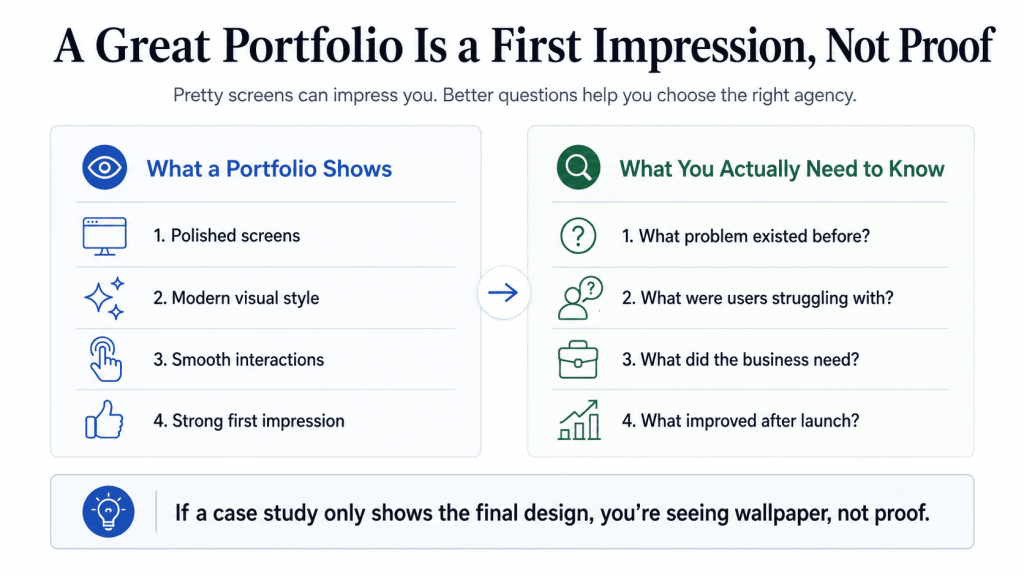
I know the pull. A polished portfolio is a great first impression, and first impressions are hard to argue with in the moment.
But screenshots lie by omission. A homepage can look stunning and still be the reason someone abandoned a quote request halfway through.
When I look at another agency’s case studies, I’ve trained myself out of the obvious question “Does this look modern?” and into the annoying one: Would this make it easier for me to become a customer of this business?
Most portfolios can’t answer that because they only show the finished screen. They don’t show what was broken before, what the business needed, what users were struggling with, or what changed after the redesign went live. Without that story, you’re not really looking at proof. You’re looking at wallpaper.
2. Great Design Starts Before Anyone Opens Figma
Here’s a mistake I see constantly: agencies racing to show you homepage mockups after one 30-minute call.
It can feel efficient at first. It skips the part of the work where the best decisions usually come from.
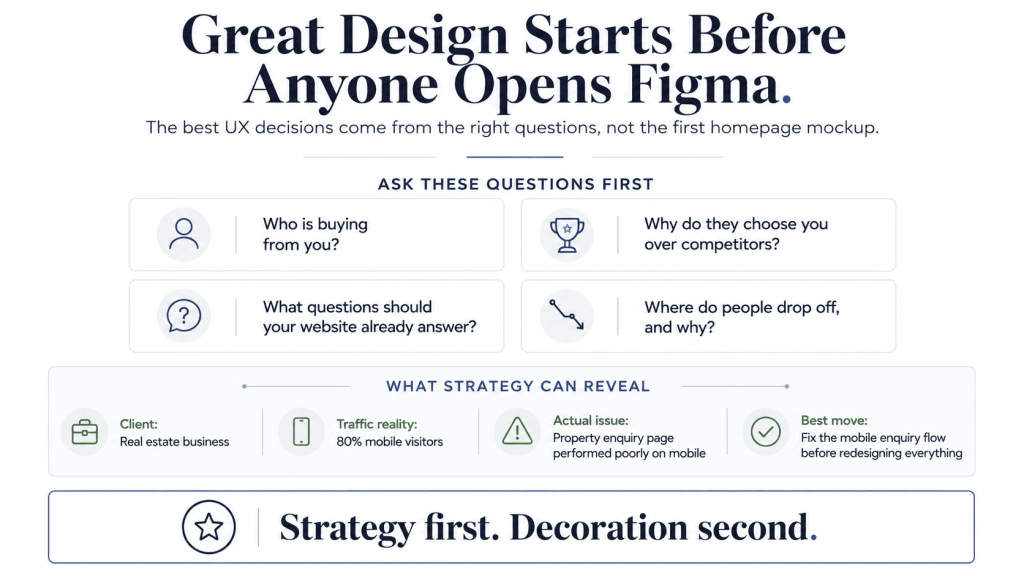
Before I care about colors, layouts, or animation, I want answers to the unglamorous questions.
- Who is buying from you?
- Why do they choose you instead of the competitor sitting three tabs over in their browser?
- What questions does your sales team answer every day that your website should already answer?
- Where do people drop off not vaguely, but on which page, at which point, and why?
I worked with a real estate client once who was sure the whole site needed a visual overhaul. After we looked closer, the real issue was much smaller and much more expensive to ignore: their property enquiry page barely worked on mobile, even though 80% of their visitors were on mobile. We fixed that first. That’s strategy, not decoration, and it’s the kind of work that rarely shows up in a portfolio screenshot.
3. Always Ask for Clickable Prototypes
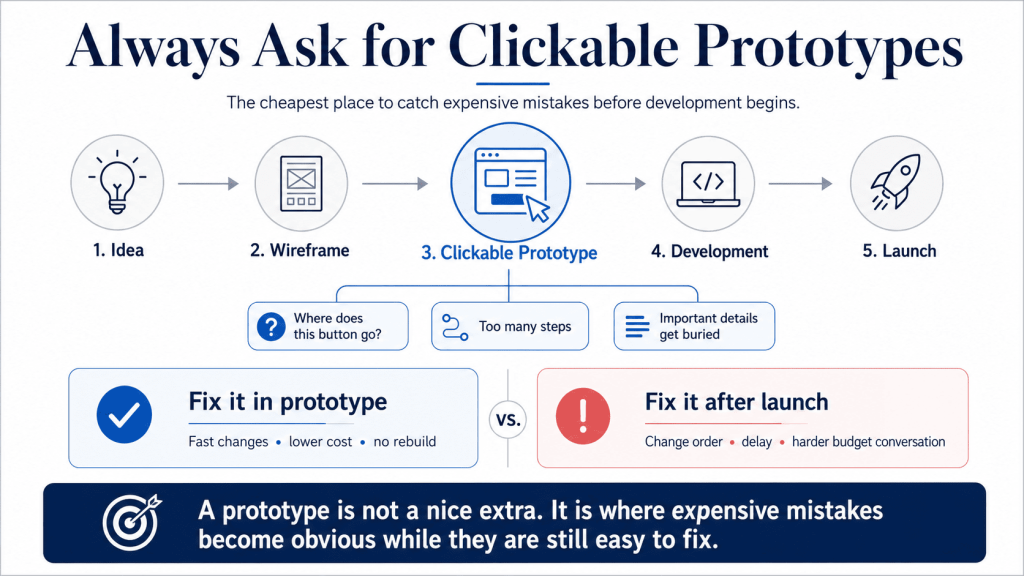
If I could insist on exactly one thing before development starts, this is it. Don’t skip clickable prototypes. Ever.
I’ve watched people click through a prototype of their own site and change their minds halfway through. “Wait, where does this button go?” is something you want to hear before development, not after launch. A flow that sounded simple in a meeting can feel clumsy the second someone actually has to use it. Important details get buried. The enquiry journey that looked like three easy steps turns into six small moments of friction.
Catching that before a developer writes a single line of code is the cheapest fix you’ll ever make on a project. Catching it after launch means a change order, a delay, and usually a harder conversation about budget.
A prototype is not a nice extra. It’s where a lot of the expensive mistakes become obvious while they’re still easy to fix.
4. Good Design Should Help Your Business Grow
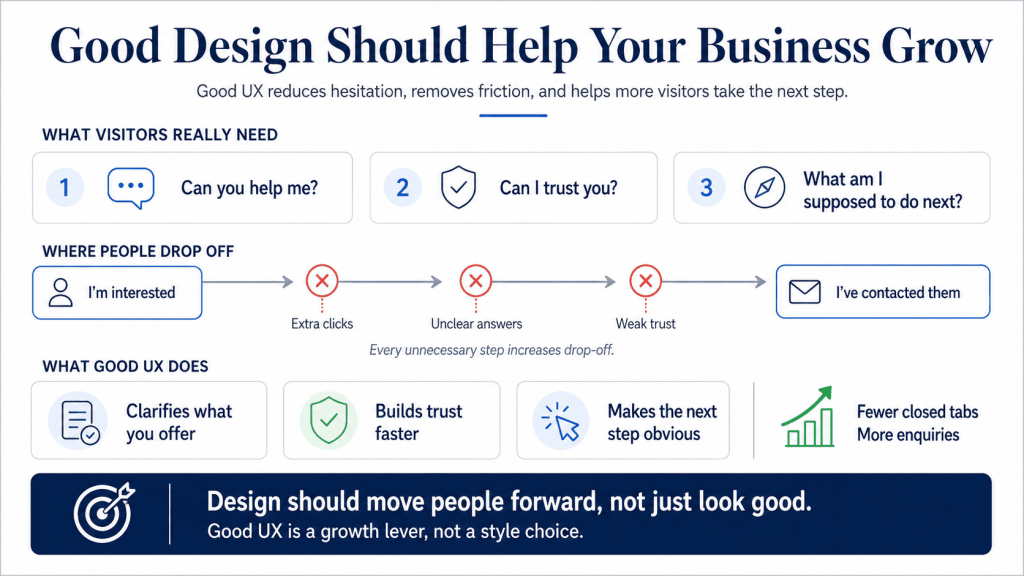
I love good design. I’ve built my career on it. But I don’t think design exists to impress anyone.
People don’t visit your website to admire the animation timing. They show up with a problem, a question, and limited patience.
1. Can you help me?
2. Can I trust you?
3. What am I supposed to do next?
Every extra click between “I’m interested” and “I’ve contacted them” is a place someone can quietly leave and never come back. You usually won’t even know if there is no complaint, no email, just a closed tab.
That’s the whole argument for treating website UX design as a growth lever instead of a style choice. It’s not about taste. It’s about how many of those closed tabs you can prevent.
5. Don’t Fall for Industry Buzzwords
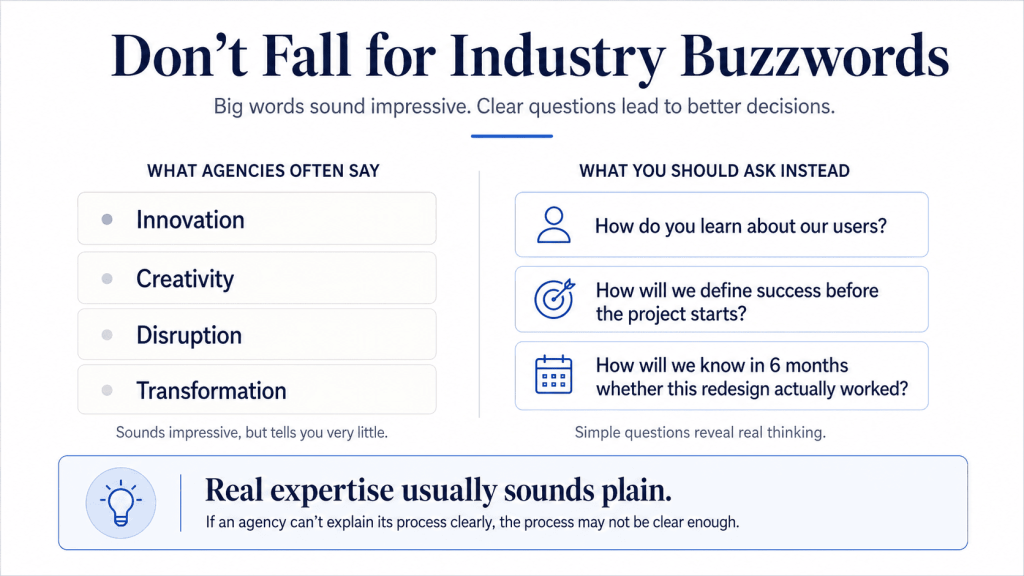
Every agency’s pitch deck has the same four words somewhere on slide two: innovation, creativity, disruption, transformation.
Those words sound big, but they don’t help a business owner make a better decision. And I say that as someone who has used a few of them in a deck before.
The better questions are much simpler. How do you learn about our users before you design anything? How will we define success before the project starts? Six months from now, how will we know whether this redesign worked instead of just looking like it worked?
Real expertise usually sounds plain when someone explains it well. If an agency can’t describe its process in normal language, the issue may not be that the work is too complex. It may be that the process isn’t very clear in the first place.
6. Communication Matters More Than Most Businesses Realize
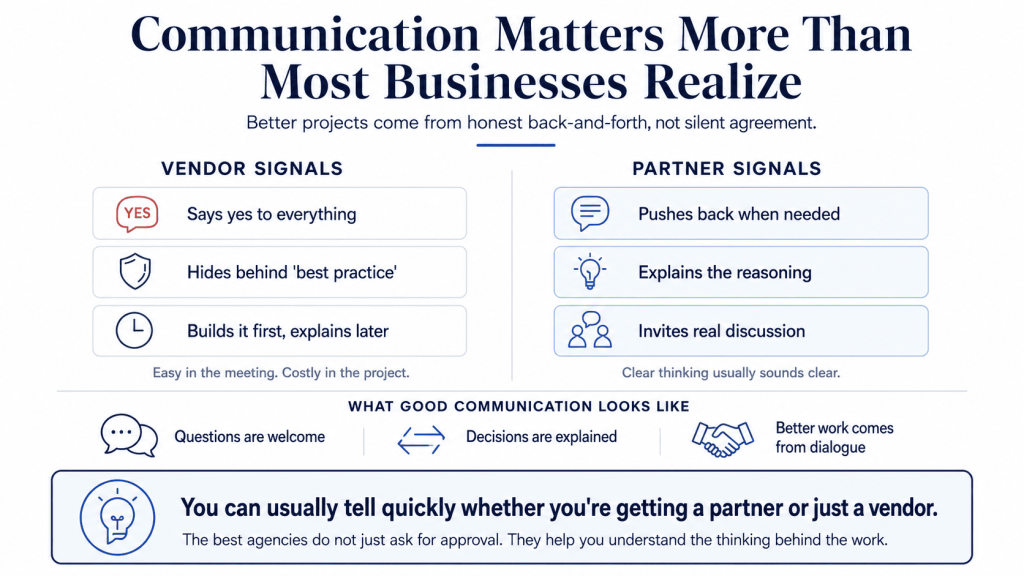
Something I learned the hard way: the projects that go well aren’t the ones where the client and agency agree on everything. They’re the ones where both sides talk.
Before you sign anything, pay attention to how the agency communicates. Will they push back if they think you’re making a mistake, or will they quietly build exactly what you asked for and let you discover the problem later? Will they explain why they decided, or hide behind “best practice” and move on?
I don’t want a client to just click “approve” on our work. I want them to understand the thinking behind it, even if they disagree. That back-and-forth is where the better work usually comes from. You can normally tell quickly whether you’re getting a partner or just a vendor.
7. Think Beyond Launch Day
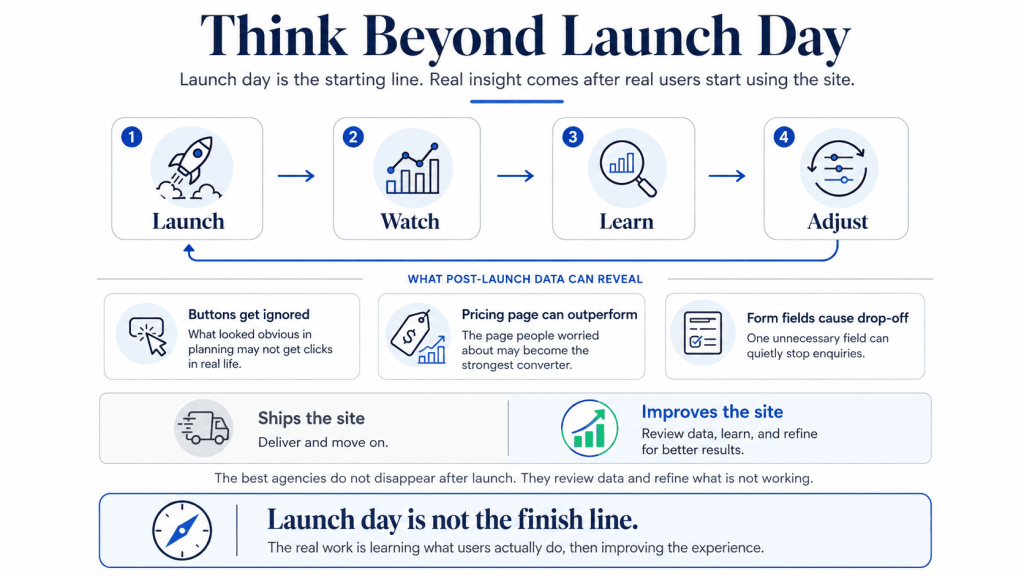
A lot of businesses treat launch day like the finish line. Site’s live, champagne, done.
I’ve never seen it work that way. Launch day is closer to the starting line because it’s the first-time real people, with real habits and distractions, start telling you what works.
Maybe the button you were sure people would click gets ignored completely. Maybe the pricing page, the one everyone worried was “too much information” turns out to be the highest-converting page on the site. Maybe your contact form has a field nobody wants to fill in, and people are abandoning it right there.
You can’t know all of that until the site is in the world. The agencies worth keeping around will look at the data with you and adjust. The ones that disappeared as soon as the final invoice clears were probably more focused on shipping the site than making sure it worked.
8. Hire People Who Care About Your Business
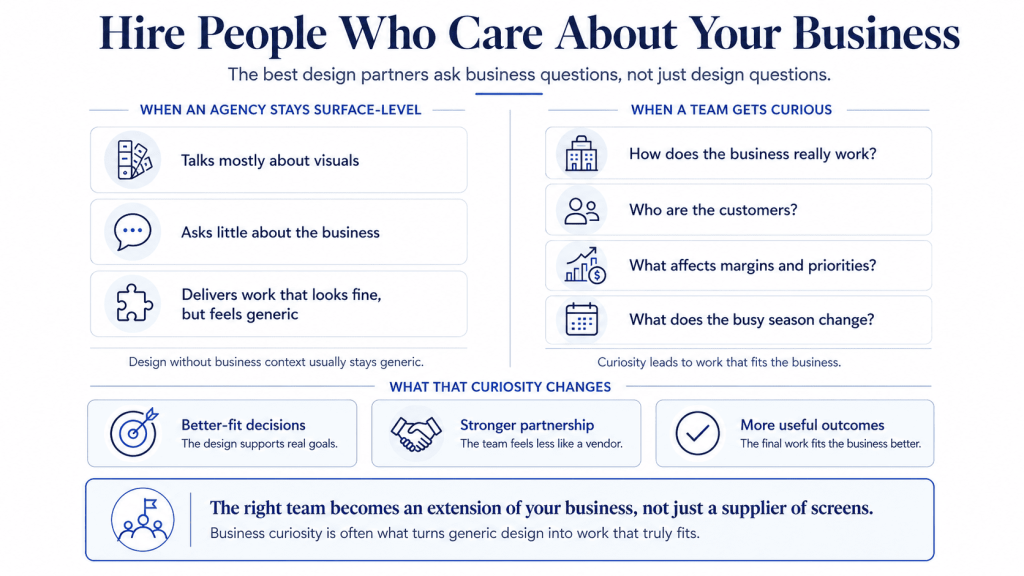
If I had to boil all of this down to one piece of advice, it’s this one.
Don’t hire people who only want to talk about design. Hire people who ask you questions about your business, your customers, your margins, your busy season, the stuff that has nothing to do with a color palette.
The best projects I’ve been part of happened because someone on our side became genuinely curious about how the client’s business works. That curiosity changes the work. It turns a generic design into something that fits. Whether you’re a startup making your first serious design investment or a larger company planning a full digital product build, you want a team that starts to feel less like an outside vendor and more like an extension of your own team.
Final Thoughts
If you’ve made it this far, here’s what I want you to take away.
Businesses don’t win because they have the prettiest website. I’ve seen plenty of pretty websites underperform. They win when people can understand them quickly, trust them quickly, and take the next step without feeling unsure.
Trends change. Tools change. But the visitor’s basic need is steady: clarity, confidence, and an obvious next step.
So, when you’re comparing UX/UI design agencies, don’t stop at the homepage screenshots. Ask how they think. Ask what their process looks like in real life, not just in a proposal. Ask how they’ll measure whether the work will pay off later. Ask them to explain a recommendation instead of simply presenting it as the answer.
Those conversations will tell you more in twenty minutes than a portfolio will tell you in twenty pages.
At American Design Hub, that’s the standard I try to hold every project to. Not just “does this look good?” but “does this make the business easier to understand, easier to trust, and easier to choose?” When the answer is yes, the site doesn’t just look better. That’s when a website stops being an expense and starts becoming one of your best business assets.
Frequently Asked Questions
The good ones research their users, shape a strategy around what they find, design the interface, test it as a clickable prototype before development, and keep improving it after launch based on how people use it.
Because visitors decide quickly whether to stay or leave. Good UX makes that short window count by giving them clear information, clear next steps, and fewer reasons to hesitate.
UX is the whole path someone takes through your site or product. Interface design is what that path looks and feels like along the way. You need both, but strong visuals can’t save a confusing experience.
Yes. They help you spot confusing flows and usability issues while they’re still easy to fix, instead of discovering them after the site has already been built.
Often, yes. Startups usually have less room for mistakes, smaller audiences, tighter budgets, and less brand recognition to fall back on if the website or product feels confusing.
Real customer research, a clear map of the paths people take through the site, a content plan that supports those paths, and conversion goals you can measure afterward.
Yes. Websites are mostly built to inform and generate leads. Product apps, SaaS platforms, and portals live or die on whether people can use them repeatedly, which is a different design problem entirely.
Pick the one that asks you more questions than it answers in the first meeting, explains its reasoning instead of hiding behind “best practices,” and talks about your business goals before it talks about your color palette.
About the Author
I’m the CEO of American Design Hub. After more than a decade in this work, the lesson that has stayed with me is simple: people don’t come to your website to admire it. They come to get something done. If this article helps you ask one better question before your next agency conversation, it has done its job.