
Make your site quotable, not just clickable.
Your website spent years climbing to rank number one on Google, only for a large language model to consume your hard work, spit out a three-paragraph summary, and send zero visitors your way.
That hurts. Welcome to the era of answer engines where traditional rank tracking goes to die.
Learning how to get found in AI search with generative engine optimization services is no longer optional if you want your digital assets to survive.
American Design Hub builds aggressive technical strategies that compel these algorithms to cite your brand rather than steal your traffic.
What is Generative Engine Optimization (GEO)?
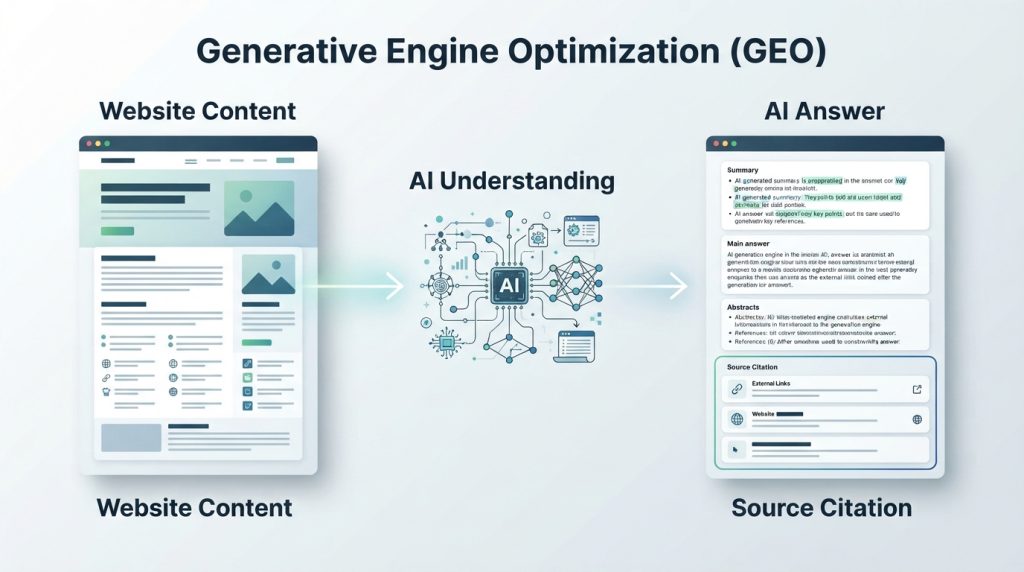
Generative Engine Optimization is the structural redesign of digital content to feed Large Language Models such as Perplexity, Claude, and Google AI Overviews.
Traditional search algorithms rank blue links based on keywords and backlinks.
Generative engines ingest millions of parameters, process contextual intent, and synthesise personalised answers directly inside the user interface.
Your technical goal shifts from winning a simple click to becoming the underlying source powering the answer.
Generative Engine Optimization targets vector databases and semantic indexers.
You structure raw facts, verifiable data points, and explicit entity relationships so neural networks parse your site without hallucination.
Specialised generative engine optimization services help technical teams convert unstructured web pages into high-confidence training nodes. When an AI crawler crawls your domain, it must recognise your authority instantly.
Ignoring this technical shift means losing visibility to competitors whose data architectures feed modern retrieval systems directly.
The S.M.A.R.T framework for GEO implementation

American Design Hub applies this framework to guarantee technical compliance across every major AI platform.
Structure
Apply JSON LD schema, clear HTML5 sectioning, and strict entity markup. This step gives AI crawlers direct access to clean semantic nodes.
Monitor
Track your brand mentions, citation frequency, and prompt placement across Perplexity, ChatGPT, and Google AI Overviews continuously.
Author
Create high-density technical content packed with original statistics, expert quotes, and precise definitions that LLMs trust.
Respond
Reformat existing data into direct answer modules, comparison tables, and succinct summaries designed for immediate AI retrieval.
Test
Run test prompts continuously to evaluate whether generative tools accurately extract your data or hallucinate false information.
Executing these five steps turns your website into an authoritative knowledge base while unprepared competitors vanish behind zero-click search engines.
How GEO Differs from SEO and Why the Rules Change
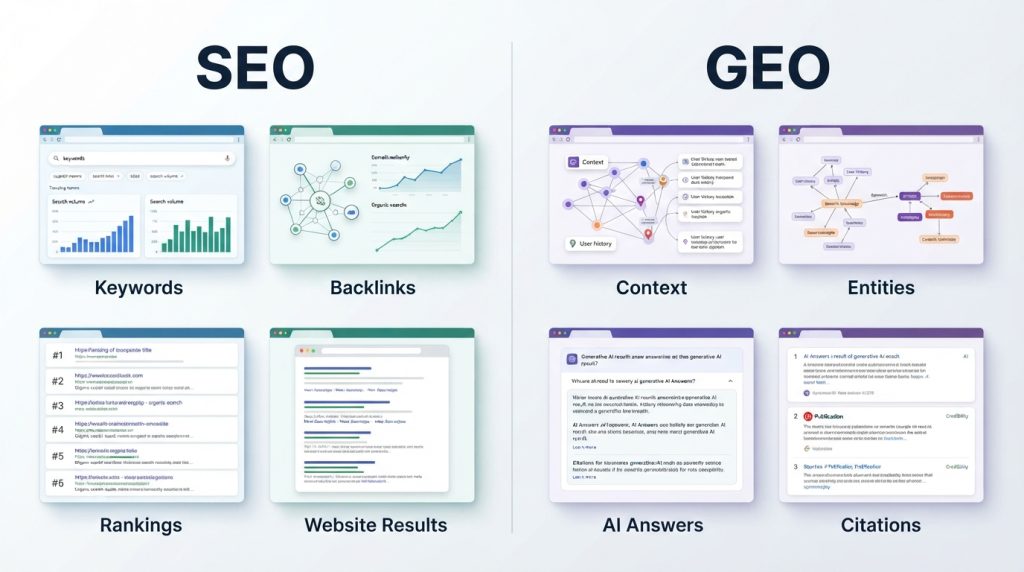
Traditional SEO focuses on crawler accessibility, keyword density, and link popularity to secure SERP rankings. Generative engine mechanics demand a complete paradigm shift.
AI models do not evaluate pages purely on backlink counts or meta keywords. They calculate semantic relevance, entity proximity, and factual confidence scores.
Search engine crawlers index web pages to rank URLs. Generative engines scrape, parse, and embed content into high-dimensional vector spaces.
Instead of matching exact search strings, LLMs process full user prompts, infer underlying intent, and synthesise unified responses.
Winning in this space means your content must serve as a primary reference point rather than a landing page destination.
If your code relies on client-side rendering or heavy JavaScript execution, generative bots bypass your content entirely.
Server-side rendering, semantic entity tagging, and explicit data statements become mandatory.
You no longer compete for top positional real estate. You compete to become the authoritative source referenced inside AI summaries.
Prompt and Query Intent Mapping for AI Search Discoverability
Users no longer type fragmented two-word keywords into search boxes. Modern users submit complex multi-sentence prompts containing specific constraints, technical conditions, and personal context.
AI search engines analyse these long inputs by breaking them down into subqueries and intent trees.
Your content strategy must map directly to these multi-step prompt paths.
Identify the exact questions your technical audience asks when troubleshooting, evaluating software, or comparing architecture options. Build answers that address root causes, potential edge cases, and technical solutions in concise text blocks.
Map primary entities to secondary contextual terms across your technical documentation.
When an AI agent decomposes a user prompt about enterprise software migration, your page must supply the exact data points required for each subquery.
Comprehensive coverage of query branches makes your content the easiest source for generative models to combine into final answers.
Building Knowledge Assets That AI Systems Can Summarize Accurately
Large language models struggle with fluff, vague claims, and ambiguous marketing jargon.
When an AI crawler encounters imprecise sentences, it skips the passage or risks hallucinating incorrect facts. Building high-value knowledge assets requires strict technical precision and factual density.
Publish proprietary research, benchmark reports, numerical data, and step-by-step processes.
Place key takeaways directly at the top of sections using declarative statements.
State facts clearly. For example, specify exact throughput metrics, system requirements, or performance statistics rather than using subjective descriptions like fast or scalable.
Structured knowledge assets give generative engines high confidence scores. AI systems prefer quoting sources that present verifiable data in unambiguous formats.
American Design Hub recommends structuring technical documentation using concise summaries, precise terminology, and bulleted technical facts.
This structure allows AI search agents to extract accurate snippets without distorting your brand messaging.
Content Structure for Retrieval Including Entities, Questions, and Relationships
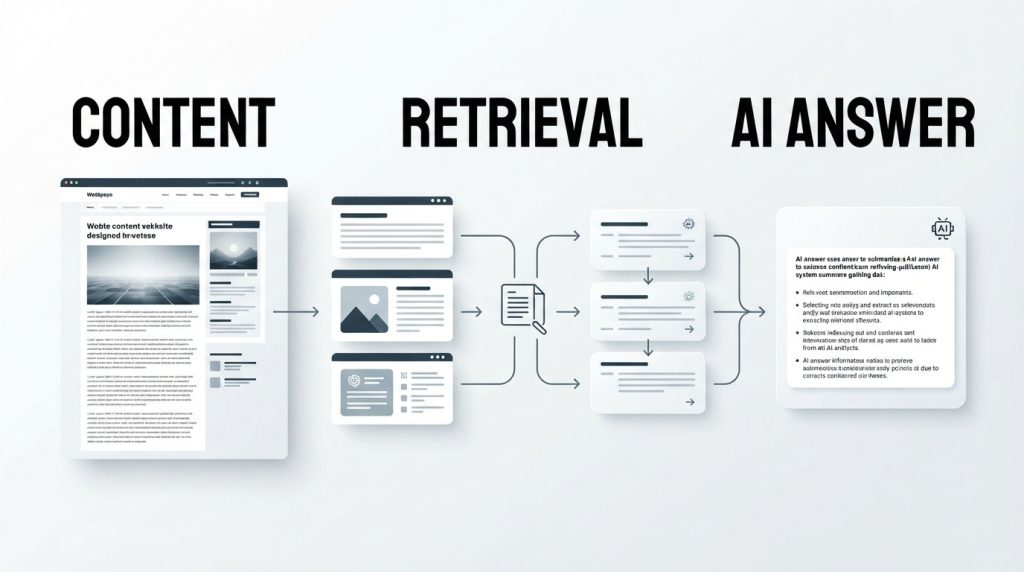
Retrieval-Augmented Generation systems scan web documents to pull context before generating a response. If your content lacks clear semantic relationships, RAG pipelines fail to match your pages with user queries.
Structuring content for retrieval requires explicit entity mapping.
Organise every article around primary entities, secondary attributes, and verified relationships.
Use clear HTML headings framed as direct technical questions. Immediately follow every heading with a direct, single-sentence answer before expanding into detailed technical analysis.
This layout creates an ideal chunking format for vector databases.
Define industry terms, technical specifications, and concept dependencies explicitly. Use JSON LD subjectOf and sameAs properties to link on-page entities to established Wikidata nodes.
When RAG systems split your page into text chunks, structured relationships ensure every individual paragraph retains complete semantic context and brand attribution.
Optimization for Citations and Source Attribution: How to Earn Trust Signals
Earning citations inside AI responses depends entirely on digital trust signals. Generative models evaluate source credibility before selecting text to quote.
Unlinked brand mentions across authoritative industry portals, academic papers, and technical forums carry significant weight in generative algorithms.
Publish original quotes from vetted industry engineers, peer-reviewed research, and verified performance metrics.
AI models actively prioritise content backed by verifiable expertise and primary data over repurposed articles. Ensure your authors have complete bio schemas linking to active professional profiles and published credentials.
Maintain consistent entity information across all third-party directories, news outlets, and technical review sites.
When multiple trusted sources reference your benchmarks, generative engines treat your domain as a primary authority.
Acquiring top-tier generative engine optimization services accelerates this authority, ensuring your brand earns consistent source attribution across every major AI platform.
Technical Implementation Checklist for Teams Including Metadata and Indexing
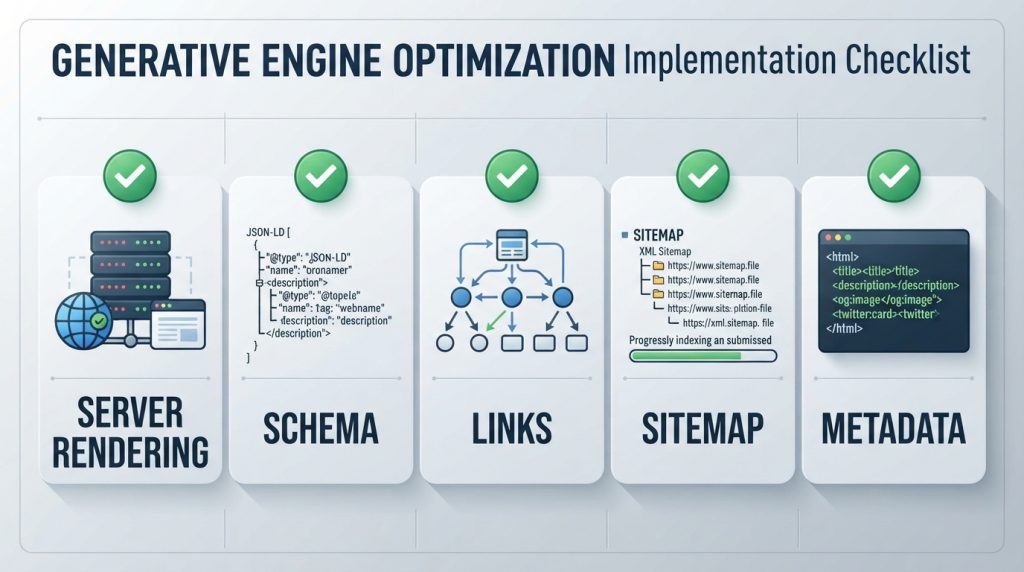
Technical architecture dictates whether generative web crawlers can read your content or get blocked at the edge.
Engineering teams must review crawl configurations to allow agents like PerplexityBot, GPTBot, and ClaudeBot inside robots txt files.
Server Side Rendering
Ensure complete HTML rendering on the server so AI bots process full text without running client-side scripts.
Schema Markup
Embed detailed JSON LD markup for Organisation, TechArticle, FAQPage, and Product entities on every page.
Link Integrity
Fix broken internal links, eliminate redirect chains, and maintain clean canonical headers to preserve crawl equity.
XML Sitemaps
Maintain clean sitemaps containing last modified timestamps to prompt immediate re-crawling of fresh data.
Metadata Precision
Write explicit meta titles and descriptions that state core facts directly without clickbait phrasing.
Executing this technical checklist prevents indexing failures and gives AI discovery engines instant access to your knowledge base.
Measurement and Reporting for GEO KPIs, Visibility Snippets, and Qualified Traffic
Traditional SEO reporting tools that rely solely on keyword positions and click counts fail to capture generative search performance.
Measuring success requires tracking brand visibility inside synthesised answers, citation rates, and referral traffic quality.
Monitor prompt sentiment, share of voice inside LLM responses, and zero-click answer inclusion across top AI platforms.
Track referral traffic from generative engines separately within analytics tools by segmenting custom user agents and referral URLs.
Visitors arriving from AI engines display higher conversion intent because the generative model pre-qualified them before sending them to your site.
Evaluate content accuracy continuously by running target prompts through automated monitoring scripts. Identify where generative models misquote your specifications or favour competitors.
Refine your entity architecture based on these visibility gaps.
Partnering with American Design Hub guarantees your technical infrastructure delivers measurable authority, high-value citations, and qualified conversion traffic across all generative engines.
Frequently Asked Questions
Generative Engine Optimization, or GEO, adapts website content so artificial intelligence tools like ChatGPT and Perplexity discover your brand.
Instead of chasing traditional blue links, you structure data, facts, and authority signals so AI models cite your business inside their direct answers.
These services re-engineer digital assets for artificial intelligence search platforms. Agencies audit your site, structure data with JSON markup, clean up technical errors, and format key knowledge.
They help neural networks parse your brand facts easily and list your website as a trusted citation source.
GEO feeds clear facts and structured data directly to AI search algorithms. Developers add schema markup, format short answer blocks, and remove technical barriers.
When users type complex prompts into answer engines, these systems scan structured nodes, extract your verified details, and generate direct citations.
Modern web searchers now use AI tools to find immediate solutions instead of clicking traditional links. Ignoring this shift costs you target web traffic and brand authority.
GEO keeps your company visible, builds industry credibility, and delivers high-quality leads before competitors capture that space.
Traditional search focuses on keywords, link popularity, and page rankings on search results pages. GEO focuses on entity relationships, factual accuracy, and vector databases.
Search engines direct users to external landing pages, while generative answer platforms synthesize multiple data sources into one direct response.
Write concise summaries, publish original research, and place factual answers directly under clear headings. Add schema markup so AI bots read your code smoothly.
Remove marketing fluff, maintain consistent entity references across web platforms, and structure complex technical data into easy bullet points.
GEO puts your brand directly inside AI search summaries, earning instant trust from users. You secure qualified traffic, boost online authority, and reach audience members who skip traditional link lists.
This proactive technical strategy protects your organic web visibility as search habits change dramatically.
Publish original statistics, clear product details, and structured expert answers on your site. Ensure search crawlers access your server-side code without JavaScript blocks.
Build unlinked brand mentions across reputable industry publications so artificial intelligence engines recognize your domain as a primary authority source.
Most specialized agencies charge between two thousand and ten thousand dollars monthly depending on campaign scope.
One-time technical setups or enterprise-level data restructuring projects can cost up to twenty-five thousand dollars. Pricing reflects technical complexity, schema depth, and continuous AI monitoring requirements.
No, GEO works alongside traditional technical strategies rather than replacing them completely. Standard search practices maintain crawler access, domain health, and fast page load speeds.
GEO builds on that base by organizing data specifically for AI models to read, summarize, and cite accurately.
Conclusion
Generative search changes how audiences discover your brand online today. Partnering with American Design Hub guarantees your content dominates AI summaries while securing trusted source citations.
Our specialised generative engine optimization services build clear entity architecture, structure raw factual data, and turn search shifts into measurable business growth.
Stop losing organic traffic to answer engines and claim your market authority.