
Most HVAC websites look like they were coded by a broken thermostat stuck in 1998. Homeowners click away faster than an old compressor dies in July. American Design Hub sees this disaster daily.
If your digital setup repels customers, you are burning cash. Building an elite HVAC company website design requires strict engineering, not generic templates. In 2026, AI search engines, Large Language Models, and generative search dominate the web.
Traditional search engine tactics fail because AI crawlers extract structural data directly to answer user queries inside chat interfaces.
Your site needs pristine technical architecture so AI models can digest your service schemas easily.
This blog guide breaks down the hardcore mechanics of weaponising your online presence.
Stop losing high-ticket installation jobs to mediocre competitors who simply have a cleaner interface.
Let us reconstruct your platform into a conversion machine.
HVAC Company Website Architecture for Fast Navigation and Better Lead Capture
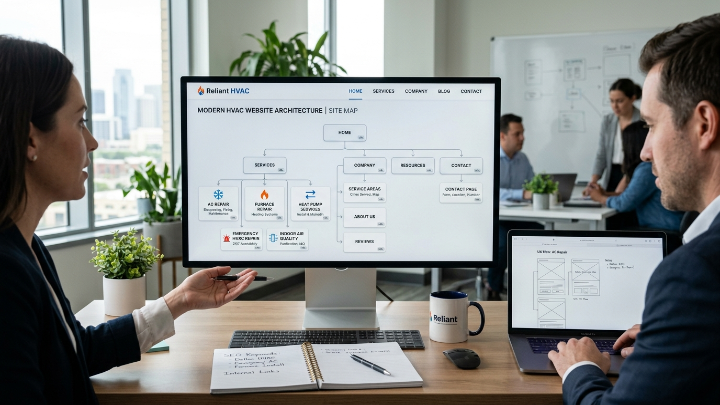
Flat information hierarchies win every time. A flat site architecture ensures users and LLM crawlers reach any page within three clicks. Group your plumbing, cooling, and heating categories cleanly.
Do not bury emergency repair pages deep within a convoluted menu directory. High-performance HVAC company website design benefits your bottom line by reducing bounce rates.
Map out clear parent-child relationships for your URLs. A logical path uses flat folders like forward slash AC repair forward slash central air. This structure helps AI engines parse your site map during generative search retrieval. Build explicit siloing for local service areas.
Keep the main navigation sticky on desktop and mobile screens. Put the click-to-call button in the top right corner.
Ensure your booking link persists during scroll events. Clean code allows search bots to crawl your conversion pipelines without getting stuck in heavy JavaScript loops.
What Your HVAC Website Should Communicate in The First 10 Seconds?
Homeowners open your page when their basement floods or their living room feels like a sauna. They do not care about your mission statement. They demand immediate answers to three urgent questions.
They need to know your exact service area, your current availability, and your core license credentials.
Display a bold headline revealing your primary city location right away. Flash your emergency phone number in massive text.
Show real-time availability badges like Technicians available now in your ZIP code.
This raw transparency anchors user attention instantly.
Do not waste the hero section on uncompressed stock photos of smiling actors pretending to fix a heat pump. Show real trucks and actual local team members.
This instant clarity satisfies modern user intent while preventing quick bounces that ruin your search engine authority.
If visitors cannot verify your legitimacy within ten seconds, they will bounce back to the search results.
Technical Service Pages That Still Feel Simple to Homeowners
Homeowners do not understand static pressure or compressor staging. They understand skyrocketing utility bills and weird banging noises in the attic.
Your service pages must bridge this knowledge gap completely. Explain complex mechanical failures by focusing on the immediate physical symptoms.
Frame your technical expertise around solving these tangible problems. Use clear diagrams showing airflow blockages instead of long paragraphs loaded with industrial engineering jargon.
Break down the mechanical process into short, digestible sentences.
This balanced approach provides exceptional ideas for small business operators looking to educate without confusing. Label components clearly using native text rather than flat images so search engine spiders can read the technical context.
Explain how modern variable-speed blowers maintain indoor air quality. Detail the exact mechanical steps your crew executes during an inspection.
Clear explanations satisfy human readers while feeding factual entities to generative search algorithms.
Designing For Search Intent: Local SEO For HVAC Companies
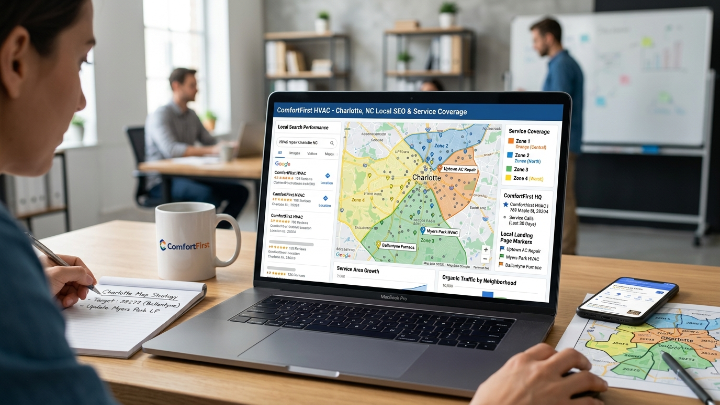
Generic keywords will kill your marketing budget. Modern local search relies heavily on specific intent matching.
Someone typing broken furnace fix near me requires immediate dispatch scheduling, not a lengthy historical blog post about heating systems.
Structure your local landing pages to match these distinct intent funnels. Group your content by transactional, informational, and navigational intent. This precise targeting forms the foundation of smart small entrepreneur ideas in competitive digital territories.
Build individual location landing pages for every suburb you service. Embed geo-targeted schema markup into the HTML of every local page. This code explicitly tells AI search engines your exact physical coordinates and operating hours.
Never copy-paste the same block of text across different city pages. Write original copy detailing local building codes and specific regional climate challenges. Search engines penalize duplicate localized fluff instantly.
Building Trust with Service Call Pages Reviews and Proof of Work
An anonymous website creates massive consumer friction. Homeowners invite your technicians into their private spaces, so they require absolute verification of your trustworthiness. Build dedicated service call landing pages that showcase undeniable proof of work.
Embed live reviews directly from verified tracking platforms rather than typing out text testimonials manually. Display real-time geographic check-ins showing where your trucks solved problems today.
Upload high-resolution pictures of actual installations featuring crisp conduit bends and level condenser pads.
Include your master technician license numbers clearly in the footer of every webpage. Partnering with a specialised HVAC web design company ensures these trust elements load perfectly without slowing down your server response times.
Present clean profiles of your field staff with background check badges. This transparency lowers consumer anxiety and accelerates buying decisions.
Mobile Performance and Speed Core Web Vitals for Booking Systems
Slow-loading booking engines destroy your advertising ROI. Most emergency service calls originate from mobile devices during high-stress situations. If your scheduling software takes five seconds to initialise, your prospect will choose a competitor.
Eliminate heavy third-party tracking scripts that block the main thread. Prioritise largest contentful paint by preloading your primary hero image. Maintain strict layout stability by defining explicit dimensions for all visual elements.
Your interactive calendar must scale perfectly on small touchscreens. Avoid tiny buttons that cause accidental clicks.
Compress your cascading style sheets and use modern web image formats to reduce page weight. Fast-loading booking portals satisfy strict Core Web Vitals metrics perfectly.
This technical maintenance guarantees your site retains high visibility in generative search environments where speed dictates ranking positions.
Explaining HVAC Systems with Plain Language Without Losing Technical Accuracy
You do not need to hide your deep industry expertise to remain accessible. Describe complex thermodynamic principles by using clear structural analogies.
Explain an air conditioner compressor by comparing it to a mechanical pump that transports heat outside rather than creating cold air.
This precise framing preserves mechanical reality while educating laymen. Avoid abstract descriptions that leave consumers guessing about what they bought.
Use precise terminology like seasonal energy rating while immediately explaining how that metric reduces monthly electricity consumption.
This strategy delivers superior HVAC company website design benefits by positioning your brand as a transparent authority. Detail the physical function of heat exchangers and multi-stage burners clearly.
When you educate customers on the physics of indoor climate control, they comfortably select premium system upgrades because they grasp the technical value.
The Data You Require from Clear HVAC Service Intake Forms and Its Importance
Long, intimidating intake forms choke your inbound lead funnel. Homeowners abandon fields asking for unnecessary personal histories when their air conditioner fails. Request only the critical variables needed to dispatch a truck without delay.
Your form must capture the precise system type, the visible symptoms, and preferred contact windows.
Use simple tap selectors for system types like heat pump or boiler instead of clunky text fields. Validate phone numbers and ZIP codes instantly using client-side script execution to prevent transmission errors.
Secure this sensitive customer data using modern transport layer security protocols. Clean data intake allows your dispatch software to route technicians accurately.
It shortens your response time significantly, which creates a massive competitive advantage. Keep the user interface uncluttered and ensure the submit button remains prominent on mobile devices.
How To Present Pricing Options, Page Design, And Variables?
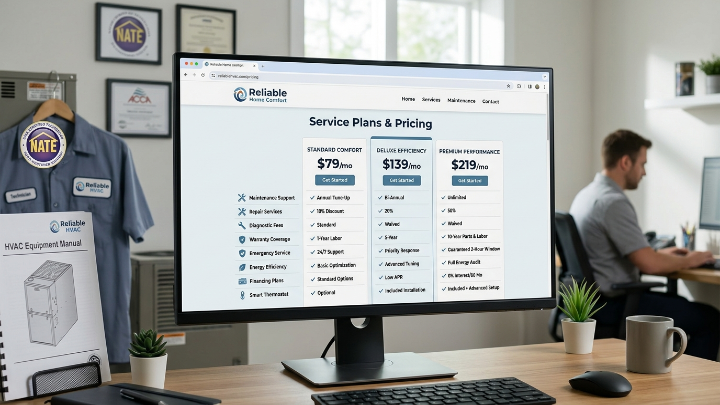
Vague pricing numbers breed immediate consumer suspicion. Present your repair and installation options using clear comparison layouts. Build structured columns separating standard, deluxe, and premium system packages.
Break down the variables affecting the total installation cost, like ductwork modifications, electrical panel upgrades, and local permit fees. Display financing monthly payment options prominently next to the total investment number.
Do not hide hidden trip fees in small print at the bottom of the page. Use clear comparison charts that highlight warranty durations and energy savings projections side by side.
Clear pricing structures reduce sales resistance before your comfort advisor even enters the home.
This direct approach establishes high credibility with modern buyers who prefer transparent digital transactions over old-school high-pressure sales tactics.
Conversion Rate Optimisation for Calls, Clicks, And Online Scheduling
Turning raw traffic into booked revenue requires relentless user experience engineering. Place prominent click-to-call elements within easy thumb reach on mobile viewports.
Implement sticky bottom navigation bars featuring a direct book online button.
Use microcopy that reduces friction, like Book in sixty seconds. Eliminate rotating image carousels that distract users from taking action. Regular split testing on your call-to-action buttons ensures you use high-contrast styling that draws the human eye naturally.
Monitor your scroll depth analytics to verify users see your financing options before leaving. Streamline your checkout experience if you sell preventative maintenance agreements directly online.
Every friction point you remove from the user pathway increases your digital conversion metrics.
This systematic execution transforms your online presence into a highly predictable customer generation system.
Frequently Asked Questions
Flat layouts allow users and search bots to find service pages within three clicks. This setup prevents visitors from leaving your site in frustration.
It lowers bounce rates and helps AI engines index data. American Design Hub designs these clean pathways to secure higher conversion rates.
Your homepage must display your specific service city, current availability, and license credentials immediately. Homeowners need fast answers during mechanical emergencies.
Avoid generic stock photos that hide your identity. Display real team photos and prominent phone numbers so prospects can book a technician without extra mobile scrolling.
Modern search engines use LLMs to extract data directly from your website structure. Clean code and schema markup allow these AI tools to understand your services without scanning messy text.
American Design Hub structures your HTML so crawlers can easily pull your operating hours and pricing options.
Homeowners care about fixing their comfort problems, not learning engineering terms. Explain physical symptoms like weird noises or weak airflow instead of obscure thermodynamic physics.
This plain language educates your audience clearly. It builds immediate trust while ensuring search engines connect your business to common customer queries.
Only request the critical details needed to dispatch your service truck immediately. Ask for the system type, visible symptoms, and the best contact window.
Long forms frustrate users and ruin your conversion pipelines. Keep fields simple so mobile users can complete the entire online booking process very quickly.
Conclusion
Your website should work as hard as your best field technician. Leaving your digital presence to chance means losing high-ticket installations to faster competitors.
American Design Hub builds high-performance digital platforms that turn casual traffic into booked service calls.
We operate as the best HVAC web design company by focusing on clear architecture and fast mobile scheduling pipelines.
Stop wasting marketing dollars and claim your local market today.
See what a high-converting HVAC site actually looks like.
We’ve rebuilt HVAC sites that turned casual traffic into booked service calls. Browse our work, then claim your local market.