
A strong brand does more than make a business look professional. It helps customers understand what a company offers, what it stands for, and why they should choose it over other options. But as a business grows, its branding can slowly become inconsistent, outdated, or disconnected from what customers expect.
That is why reviewing your brand from time to time matters. A brand audit gives you a clear look at what is working, what needs attention, and how your brand compares with others in the market.
Today, businesses have more platforms to manage than ever before. From websites and social media to search results, emails, reviews, and customer support, every interaction can shape how people remember a business. Reviewing these touchpoints can help you spot gaps, strengthen your message, and create a more consistent brand experience.
What Is a Brand Audit?
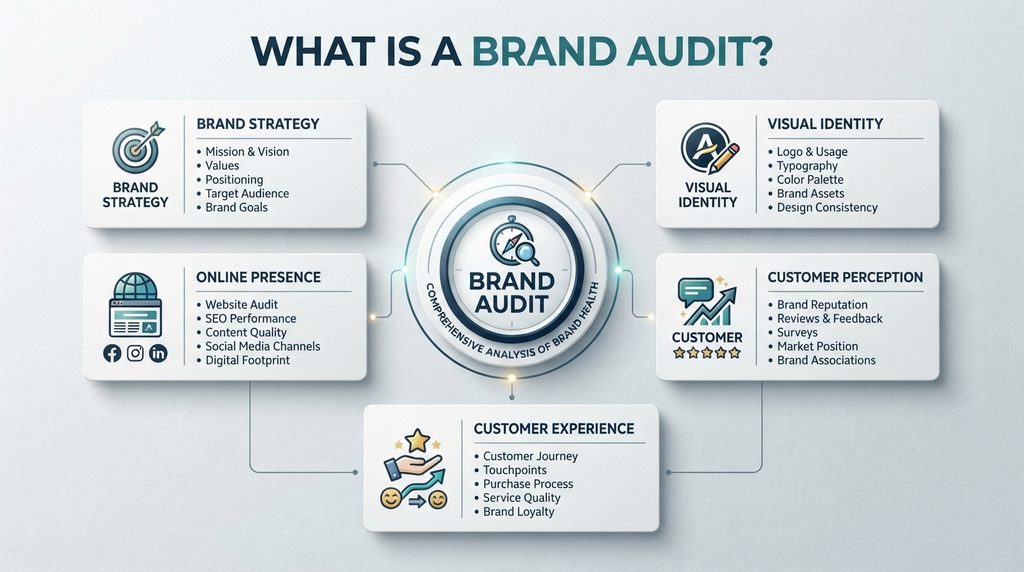
A brand audit is basically a detailed review of how a business presents itself and how people perceive it. It looks at the different parts of a brand, from its strategy and visual identity to its online presence and customer experience.
The goal is not simply to decide whether a logo looks good. Instead, you want to answer bigger questions.
- Is the brand clear?
- Does it stand out from competitors?
- Does it speak to the right audience?
- Does the customer experience match what the business promises?
Imagine a family restaurant that describes itself as friendly and welcoming but has a cold looking website, confusing menus, and slow customer support. The business may have a strong product, but its brand experience does not support its message.
A useful brand audit brings these differences to light so the business can make smarter decisions.
Why Is a Brand Audit Important?
Your brand influences what customers expect before they ever buy from you. When your message, visuals, and customer experience work together, people are more likely to understand what you offer and remember your business.
An audit can also uncover problems that are easy to miss when you are too close to your own business. You may believe your message is clear because you understand it, while a new customer may find it confusing.
It can help you find outdated content, inconsistent visuals, weak positioning, and missed opportunities. It can also show you what is already working well, which is just as important.
Instead of making random changes, you can use the findings to decide where your time and money will have the greatest impact.
When Should You Conduct a Brand Audit?
There is no single perfect time for every business. However, certain moments make a review especially useful.
You may want to review your brand when your business is growing, entering a new market, launching a major product, changing its target audience, or preparing for a rebrand. It can also help when marketing results have dropped, or customers seem less engaged than before.
A major change in the market is another good reason. Customer preferences can shift, competitors can introduce new ideas, and digital platforms can change how people discover businesses.
You do not need to wait until something is wrong. Reviewing your brand regularly can help you spot small problems before they become expensive ones.
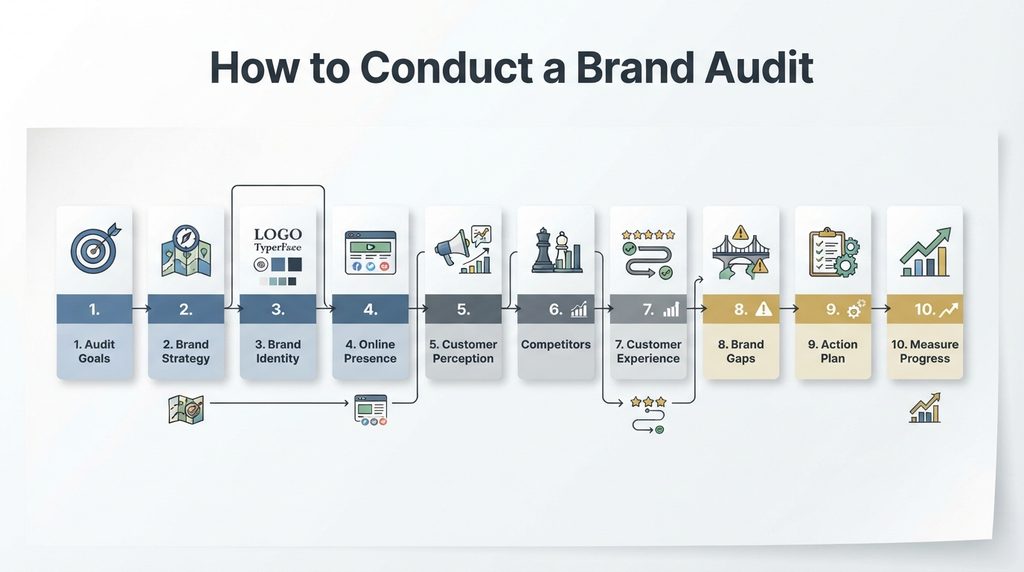
How to Conduct a Brand Audit Step by Step
Step 1: Define Your Brand Audit Goals
Before you start collecting information, decide what you want to learn. A clear goal keeps the process focused and stops you from spending hours reviewing things that do not matter.
Perhaps you want to know why customers are not recognizing your business. Maybe your website and social media feel different, or your business has grown, and the old positioning no longer fits.
Write down a few questions you want the audit to answer. For example, you might ask whether customers understand your main value, whether your branding is consistent, or whether your business stands out from competitors.
Once you know what you are looking for, the rest of the process becomes much easier.
Step 2: Review Your Brand Strategy
Next, go back to the foundation of your brand. Review your mission, vision, values, target audience, positioning, unique value proposition, and personality.
Ask whether these elements still describe the business today. A company that started as a small local service may have changed significantly after several years of growth.
Your target audience may have changed too. If your ideal customer is different from the person you originally built the brand for, your message may need to change with them.
This stage gives you something to compare everything else against. Your website, social posts, advertisements, and customer interactions should support the same basic direction.
A clear foundation is also important when reviewing your overall brand strategy.
Step 3: Audit Your Brand Identity
Now look at the parts of your brand that customers can see and hear. Review your logo, colors, fonts, photography, graphics, tagline, messaging, and tone of voice.
Check whether these elements feel consistent. For example, if your website uses a professional tone but your social media sounds completely different, customers may wonder whether they are dealing with the same company.
Also consider whether your identity still fits your audience. A design that worked well ten years ago may not communicate the same message today.
The goal is not to change everything. Keep the elements that work and identify the ones that no longer support your brand.
For businesses that need to strengthen these visual elements, reviewing their brand identity design can help identify areas that need improvement.
Step 4: Audit Your Online Presence
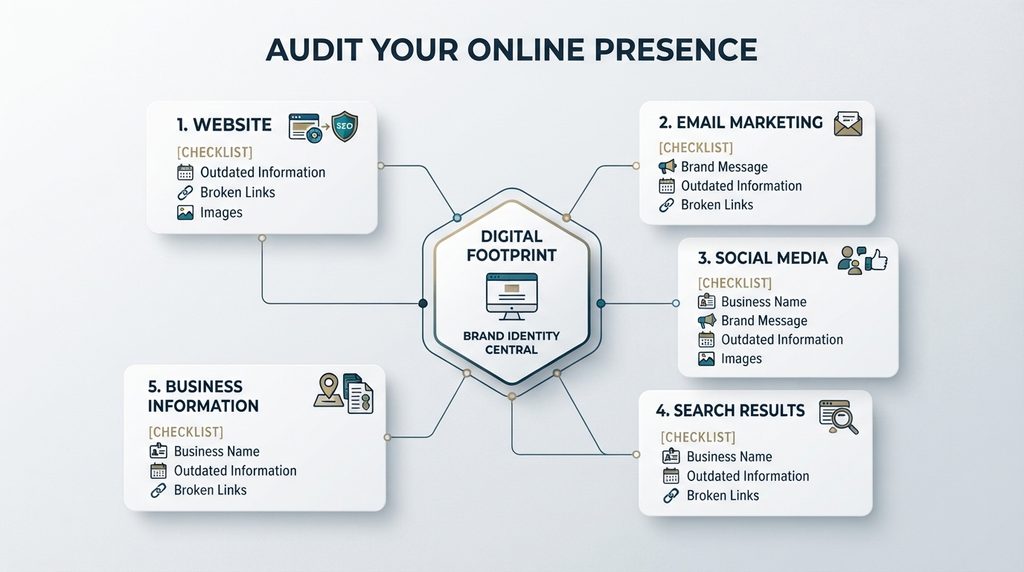
Brands online presence is often the first place people meet your business, so it deserves careful attention. It is essential to review your brand’s website, email marketing, social media handles, and other important digital channels.
Look for outdated information, broken links, inconsistent descriptions, old images, and different versions of your business name or message.
Think about the experience from a customer’s point of view. If someone discovers you through Google, visits your website, and then checks Instagram, does everything feel connected?
A strong online presence should make it easy for people to understand who you are, what you offer, and what they should do next.
Your website is a major part of this review, so checking your current website design and development is an important part of the audit.
Step 5: Analyze Customer Perception
There is an important difference between what you want your brand to say and what customers actually understand. That is why customer feedback is one of the most valuable parts of the process.
Look at reviews, surveys, testimonials, social media comments, support conversations, and customer interviews. Pay attention to repeated words and themes.
If customers often describe your business as helpful, fast, and simple, those qualities may be part of your strongest identity. On the other hand, if people repeatedly mention confusion or poor communication, you have a problem worth investigating.
Do not just look for the compliments. Honest criticism can show you exactly where improvements are needed.
Step 6: Compare Your Brand with Competitors
A business does not exist alone. Customers are comparing you with other options, even if they never say so directly.
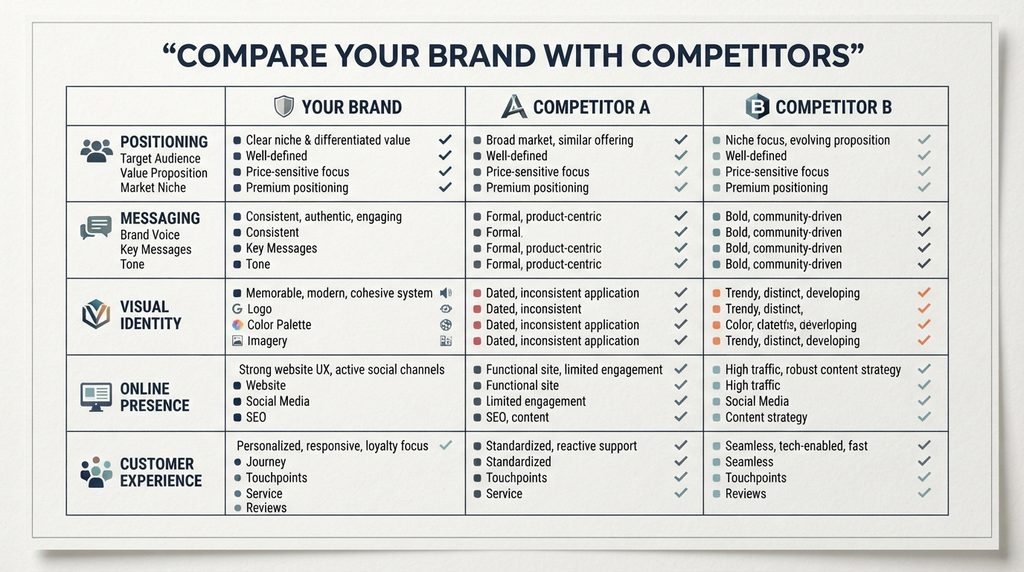
Choose a few relevant competitors and compare their positioning, visual identity, online presence, messaging, customer experience, and content with yours. The goal is not to copy them. It is to understand where your business fits and where it can stand apart.
A simple table can make this easier:
| Brand Area | Your Brand | Competitor A | Competitor B |
|---|---|---|---|
| Positioning | What makes us different? | What do they focus on? | What do they focus on? |
| Messaging | Main promise and tone | Main promise and tone | Main promise and tone |
| Visual Identity | Look and feel | Look and feel | Look and feel |
| Online Presence | Website and social channels | Website and social channels | Website and social channels |
| Customer Experience | Strengths and gaps | Strengths and gaps | Strengths and gaps |
This comparison can reveal areas where your brand feels too similar, unclear, or less memorable.
Step 7: Review the Customer Experience
Your brand is more than what people see in advertisements. It is also what they experience after they decide to interact with your business.
Follow the customer journey from beginning to end. Consider how easy it is to find information, make a purchase, get help, receive updates, and contact your team.
Imagine a company promising simple and stress-free service. If its website is difficult to use and customers have to contact three different departments for help, the experience does not support the promise.
A strong brand makes its promise and then delivers on it. When those two things match, customers have a clearer reason to trust the business.
Step 8: Identify Brand Gaps and Inconsistencies
At this point, you should have enough information to identify the biggest gaps. Look for differences between what the brand wants to communicate and what customers actually experience.
You might find that your visuals are outdated, your message is unclear, or your website communicates something different from your social media. You may also discover that competitors are doing a better job of explaining a benefit that makes your business special.
Do not try to fix everything at once. Focus on the problems that can make the biggest difference.
A short list of important findings is usually more useful than a long report filled with minor issues.
When outdated logos or visual marks are part of the problem, a logo redesign may be one area worth evaluating.
Step 9: Create a Brand Improvement Action Plan
Finding problems is only half the job. The next step is turning those findings into practical actions.
Start by ranking each issue according to its importance and potential impact. For instance, an unclear value proposition may deserve attention before changing the color of a button on your website.
Give each priority a clear action and, where possible, an owner and deadline. This turns your findings into a working plan instead of letting them sit in a document that nobody opens again.
The best action plans are realistic. You do not need to rebuild the entire brand in one week. Small, well-planned improvements can create meaningful results over time.
Ready to Strengthen Your Brand?
Turn your audit findings into clear, practical improvements that help your brand stand out and connect with the right audience.
Build a Stronger BrandStep 10: Measure Progress and Keep Your Brand Consistent
Once changes are made, keep checking whether they are helping. Look at customer feedback, brand awareness, website behavior, engagement, and other measures that match your original goals.
For example, if your main problem was confusing messaging, ask whether customers now understand your offer more easily. If consistency was the issue, check whether your updated branding appears the same across important channels.
A brand audit should lead to continuous improvement rather than becoming a one-time task. Your business will change, your customers will change, and the market will change. Your brand should be ready to change with them.
One useful way to maintain consistency is to create clear brand style guidelines that your team can follow across different channels.
Common Brand Audit Mistakes to Avoid
Even a well-planned review can lose its value if you approach it the wrong way. One common mistake is focusing almost entirely on the logo and other visual elements. Your brand includes much more than its appearance.
Another mistake is ignoring customer opinions. Internal teams know the business well, but customers see it from a completely different angle. Their feedback can reveal problems you may never notice yourself.
It is also easy to become distracted by competitors. Their strategies can provide useful clues, but your goal should be to build a stronger identity for your own business.
Finally, avoid trying to fix everything at once. Too many changes can create confusion and waste resources. Choose the most important improvements first.
Brand Audit Checklist for 2027
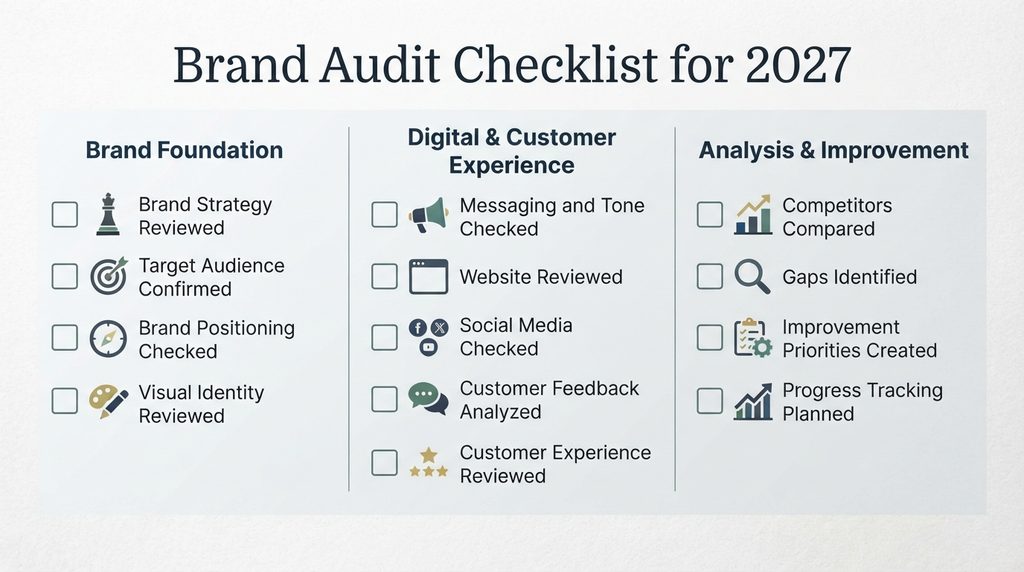
Use this quick checklist when reviewing your brand:
- ☐ Brand strategy reviewed
- ☐ Target audience confirmed
- ☐ Brand positioning checked
- ☐ Visual identity reviewed
- ☐ Messaging and tone checked
- ☐ Website reviewed
- ☐ Social media checked
- ☐ Customer feedback analyzed
- ☐ Competitors compared
- ☐ Customer experience reviewed
- ☐ Gaps identified
- ☐ Improvement priorities created
- ☐ Progress tracking planned
This checklist is simple, but it covers the major areas most businesses should consider. You can also add industry-specific items that matter to your customers.
How Often Should You Conduct a Brand Audit?
For many businesses, reviewing the brand once a year is a useful starting point. However, you may need to do it sooner if your company is growing quickly or going through a major change.
Annual review gives you a chance to catch outdated information and compare your current position with your previous goals. Smaller check-ins during the year can help you keep important channels consistent.
The right schedule depends on your business. A fast-growing company may need more frequent reviews than an established business with a stable market.
The important thing is to make brand reviews part of your normal planning process rather than waiting for a serious problem to appear.
Turn Your Brand Audit into Brand Growth
A strong brand is not created once and then left alone. It grows as your business, customers, and market change. That is why a brand audit can be such a useful tool.
The process does not have to be complicated. Start with clear goals, check your identity and online presence, review your strategy, listen to customers, compare your position with competitors, and identify the biggest gaps.
Most importantly, do something with what you discover. A list of problems will not strengthen your brand on its own. The real value comes from turning those findings into clear improvements. American Design Hub can help you turn those insights into practical branding solutions that keep your brand consistent and aligned with your business goals.
Frequently Asked Questions
A brand audit is a complete review of how a business presents itself and how customers perceive it. It examines areas such as brand strategy, visual identity, messaging, online presence, customer experience, and competitive positioning. The goal is to find what is working, what is inconsistent, and where the brand can improve.
A brand audit helps a business understand whether its brand still connects with its target audience. It can uncover outdated visuals, unclear messaging, inconsistent branding, customer experience gaps, and missed opportunities. These insights help businesses make more informed branding and marketing decisions.
Start by defining your goals, then review your brand strategy, identity, messaging, and online presence. Next, study customer feedback and compare your positioning with competitors. Finally, identify the biggest gaps, create an action plan, and track the results of your improvements.
A thorough review should cover your brand strategy, target audience, positioning, visual identity, messaging, website, social media, customer perception, competitors, and customer experience. It should also identify important gaps and provide clear recommendations for improvement.
Many businesses can benefit from conducting a brand audit once a year. However, a business may need one sooner after major changes such as a rebrand, rapid growth, a new target market, or a significant shift in customer behavior or competition.
The time depends on the size and complexity of the business. A small business with a few marketing channels may complete a basic review in a few days, while a larger company with multiple products and platforms may need several weeks for a more detailed audit.
The main steps include defining your goals, reviewing your brand strategy, auditing your identity and online presence, analyzing customer perception, comparing competitors, reviewing the customer experience, identifying gaps, creating an action plan, and measuring progress.
Your brand may need a review if your messaging feels unclear, different channels use inconsistent branding, customer engagement has dropped, competitors are gaining attention, or your business has changed significantly. An audit can also be useful when you feel your brand no longer reflects where the business is today.
A brand audit examines your brand as it currently exists. It looks at what is working, what is not, and how customers and competitors view it. A brand strategy defines where you want the brand to go and how you plan to position, communicate, and grow it. In simple terms, an audit helps you understand your current position, while a strategy helps determine your next direction.
A brand audit can help you create a clearer message, improve brand consistency, strengthen your market position, understand customers better, and identify areas for growth. By acting on the findings, you can build a brand that is easier to recognize, trust, and remember.