
B2B buyers are smarter, more careful, and more informed than ever in 2026. Before they contact a company, they search, compare, read reviews, check case studies, and discuss options with their team.
This means your website must do more than rank on Google. It must answer real questions and build trust from the first visit. That is where a strong B2B SEO strategy makes a difference.
It helps your business reach the right decision-makers, attract serious buyers, and turn organic visibility into qualified leads. With the right approach, SEO becomes more than traffic it becomes a steady path to business growth.
What Is B2B SEO?
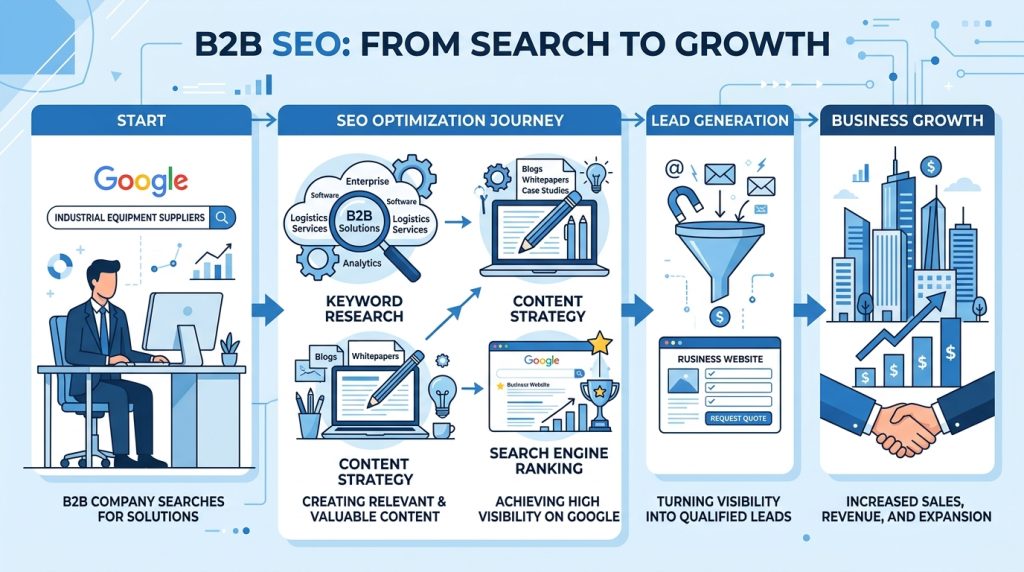
B2B SEO means business-to-business search engine optimization. In simple words, it is the process of improving your website so other businesses can find you on search engines like Google.
For example, if a company needs accounting software, cybersecurity services, HR tools, or a marketing agency, someone from that company may search online first. If your website appears when they search, you have a chance to win that lead.
A good B2B SEO strategy helps your website show up for the words and questions your target customers are already typing into Google. It includes keyword research, website optimization, content writing, technical SEO, and link building.
B2B SEO Meaning in Simple Terms
Think of B2B SEO like placing helpful signs on the internet. These signs guide the right businesses to your website. But these signs are not random. They are built around the problems your customers have and the solutions your company offers.
For example, a simple blog post like “how to choose a project management tool for a remote team” can attract business leaders who are looking for software. A service page like “enterprise project management software” can attract buyers who are closer to making a decision.
That is why a B2B SEO strategy should focus on both education and conversion.
How B2B SEO Differs from B2C SEO
B2B SEO is different from B2C SEO because the buying journey is usually longer and more complex.
In B2C, one person may search for shoes, compare a few options, and buy them the same day.
In B2B, the process is slower. A company may take weeks or months to choose a service or product. More people are involved, such as managers, directors, finance teams, and executives.
B2B keywords may also have lower search volume. But they can bring more valuable leads. For example, only a few people may search for “enterprise CRM implementation services,” but each lead could be worth thousands of dollars.
This is why B2B SEO needs more trust, more detail, and stronger proof. Your content must show expertise, answer deep questions, and help buyers feel confident.
Why B2B SEO Matters in 2026

B2B SEO matters because buyers are in control now. They do not want to be pushed into a sales call too early. They want to learn first. They want to compare options. They want to understand the cost, benefits, risks, and results.
A smart B2B SEO strategy puts your business in front of these buyers while they are researching.
B2B Buyers Are Doing More Research Before Contacting Sales
Most B2B buyers do not contact a company the moment they discover a problem. First, they search online. They read guides. They ask questions. They compare companies. They look for case studies and reviews.
This means your website should act like a helpful salesperson that works all day. It should explain your services clearly, answer common questions, and help visitors understand why your solution is a good fit.
If your website does not show up during the research stage, your competitors may win the buyer’s trust before you even know the buyer exists.
Organic Search Builds Long-Term Pipeline
Paid ads can bring quick traffic, but the moment you stop paying, the traffic often stops too. SEO works differently. When you build strong content and improve your website over time, your pages can keep bringing visitors for months or even years.
That is why a B2B SEO strategy is a long-term growth asset. It helps your business build a steady pipeline of leads without depending only on ads.
SEO also supports your sales team. When prospects find helpful content on your website, they may come to sales calls already educated and more ready to talk.
Ranking Higher Means Capturing High-Intent Buyers
Some people search because they are curious. Others search because they are ready to buy. A good SEO plan targets both, but high-intent searches are especially important.
For example, someone searching “what is CRM software” may just be learning. But someone searching “best CRM software for B2B sales teams” may be much closer to choosing a solution.
A strong B2B SEO strategy helps you rank for these important search terms so you can reach buyers at the right time.
The Foundation of a Successful B2B SEO Strategy
Before writing blogs or choosing keywords, you need a clear foundation. Without a clear plan, SEO becomes random. You may publish content, but it may not bring the right results.
Define Your Ideal Customer Profile
Start by knowing exactly who you want to reach. Ask simple questions:
Who is your best customer? What industry are they in? How big is their company? What problems do they face? Who makes the buying decision? What makes them search for a solution?
For example, a software company may target HR managers at mid-sized businesses. A cybersecurity agency may target IT directors at financial firms. A marketing agency may target SaaS founders.
When you know your ideal customer, your B2B SEO strategy becomes sharper. You can create content that speaks directly to their needs.
Map SEO to the B2B Buyer Journey
Every buyer moves through stages. Your SEO content should support each stage.
At the awareness stage, buyers are learning about a problem. They may search for topics like “why is our website traffic dropping?” or “how to improve lead quality.”
At the consideration stage, buyers compare solutions. They may search for “SEO agency vs in-house SEO” or “best lead generation strategies for B2B companies.”
At the decision stage, buyers are ready to act. They may search for “B2B SEO agency,” “SEO services for SaaS companies,” or “book SEO consultation.”
A complete B2B SEO strategy includes content for all three stages, not just basic blog posts.
Align SEO Goals with Business Goals
SEO should not only be measured by rankings. Rankings are useful, but business results matter more.
Your SEO goals should connect with leads, demo requests, consultation bookings, form submissions, sales calls, pipeline value, and revenue.
For example, getting 10,000 visitors from the wrong audience is not as useful as getting 500 visitors from companies that are likely to buy. A good B2B SEO strategy focuses on quality over quantity.
Step-by-Step B2B SEO Strategy for 2026
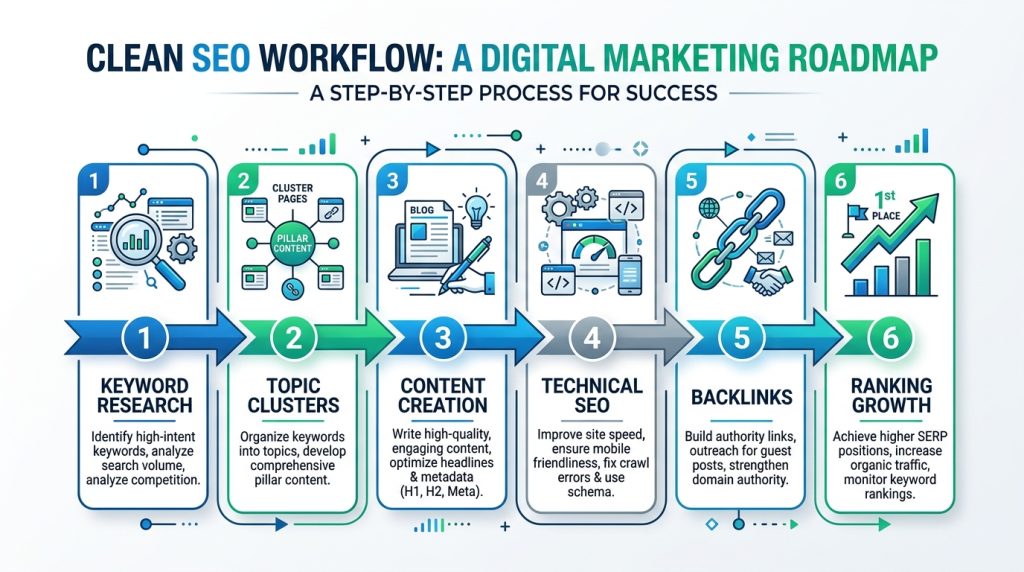
Now, let’s look at the main steps you need to build a strong SEO plan.
Step 1: Perform B2B Keyword Research Based on Intent
Keyword research is the starting point. But you should not only chase high-volume keywords. You need to understand search intent.
Informational keywords help people learn. These include searches like “what is B2B SEO” or “how to improve organic traffic.”
Commercial keywords show that people are comparing options. These include searches like “best SEO agency for B2B companies” or “top CRM tools for sales teams.”
Transactional keywords show buying intent. These include searches like “hire B2B SEO consultant” or “book SEO audit.”
A powerful B2B SEO strategy uses all three types, but gives special attention to keywords that can bring qualified leads.
Step 2: Build Topic Clusters Around Core Services
Topic clusters help your website build authority. Instead of writing random articles, you create one main pillar page and several supporting blogs around it.
For example, if your main service is B2B SEO, your pillar page could be “B2B SEO Services.” Supporting blogs could include “B2B Keyword Research,” “B2B Technical SEO,” “B2B Content Strategy,” and “How to Measure B2B SEO Results.”
Then you link these pages together. This helps users explore your content and helps search engines understand your expertise.
Step 3: Optimize Service and Solution Pages
Many businesses focus only on blogs and forget their service pages. This is a mistake. Service pages are often where serious buyers convert.
Your service pages should have clear headings, strong benefits, proof points, FAQs, calls to action, and simple explanations. They should also include keywords naturally.
For example, instead of saying “We help businesses grow,” say exactly what you do: “We build SEO strategies that help B2B companies rank higher and generate qualified leads.”
This makes your offer clearer and stronger.
Step 4: Create Helpful, Expert-Led Content
In 2026, thin content is not enough. Your content should feel helpful, real, and expert-led.
Write guides, comparison pages, case studies, problem-solution articles, and industry-specific content. Use examples. Explain things simply. Show that you understand the buyer’s challenges.
A good B2B SEO strategy does not create content only for search engines. It creates content for real people who need answers.
Step 5: Improve Technical SEO Performance
Technical SEO helps search engines crawl, understand, and rank your website.
Focus on site speed, mobile usability, clean URLs, proper indexing, internal links, schema markup, and simple site structure. Your website should load fast and be easy to use.
Even great content can struggle if your website has technical problems. That is why technical SEO is a key part of every B2B SEO strategy.
Step 6: Build Authority with Quality Backlinks
Backlinks are links from other websites to yours. They help build trust and authority.
For B2B companies, good backlinks can come from guest posts, industry websites, partner pages, digital PR, research reports, directories, podcasts, and expert roundups.
Do not focus on spammy links. Focus on quality. One strong link from a respected industry website can be more valuable than many low-quality links.
Step 7: Track SEO Performance Beyond Traffic
Traffic is only one part of the story. You also need to track what visitors do after they arrive.
Track keyword rankings, organic leads, form submissions, demo bookings, consultation requests, assisted conversions, and pipeline contribution.
This helps you understand which pages bring business value. A mature B2B SEO strategy always connects SEO activity with real business outcomes.
Best Types of Content for B2B SEO
Different content types support different stages of the buyer journey.
- Educational blog posts help people understand a problem. They are great for awareness-stage traffic and topical authority.
- Comparison and alternative pages help buyers compare options. These pages can attract people who are closer to making a decision.
- Case studies and success stories build trust. They show real results and help buyers believe that your company can deliver.
- Industry-specific landing pages help you target niche audiences. For example, “SEO services for SaaS companies” speaks more clearly than a general service page.
- Product or service pages are built to convert. These pages should explain what you offer, who it is for, why it matters, and what the visitor should do next.
A complete B2B SEO strategy uses all these content types together.
Common B2B SEO Mistakes to Avoid
- One common mistake is targeting keywords with traffic but no buying intent. High traffic looks good, but it does not always lead to sales.
- Another mistake is ignoring bottom-of-funnel pages. These include service pages, comparison pages, alternative pages, and industry landing pages. These pages often bring the most valuable leads.
- Many companies also publish content without a clear plan. Random blogging does not build authority. Every piece of content should support a larger topic or business goal.
- Some businesses measure SEO only by traffic. But qualified leads, conversion rates, and sales opportunities are more important.
- Finally, many websites forget trust signals. Add testimonials, client logos, case studies, author expertise, certifications, and clear contact options. These small details help buyers feel safe.
Avoiding these mistakes can make your B2B SEO strategy much stronger.
How Long Does B2B SEO Take to Show Results?
B2B SEO takes time. It is not a one-week growth trick. Most businesses may see early movement in a few months, but stronger results usually take consistent work over time.
New websites often take longer because they need to build authority from the ground up. Established websites may see faster results if they already have content, traffic, and backlinks.
Competitive industries also require more effort. If many strong companies are already ranking, you need better content, stronger pages, and more authority.
The key is consistency, and a clear B2B SEO strategy builds momentum month by month.
How to Measure B2B SEO Success in 2026

To measure SEO success, start with organic keyword growth. Track whether your website is ranking for important informational, commercial, and transactional keywords.
Next, look at qualified organic traffic. Do not only ask how many people visited. Ask whether the right people visited.
Then measure lead quality and conversion rate. Are visitors filling out forms? Are they booking demos? Are they becoming real sales opportunities?
You should also measure revenue and the influence on the pipeline. When possible, connect SEO data with your CRM. This helps you see which pages and keywords support real business growth.
A results-focused B2B SEO strategy makes it easier to prove and improve SEO.
Conclusion
Ranking higher in 2026 is important, but it is not the final goal. The real goal is to attract the right buyers, answer their questions, build trust, and turn organic search into qualified leads.
A strong B2B SEO strategy helps your business show up when buyers are searching, guide them through the decision process, and support long-term growth.
If your B2B website is getting traffic but not leads, or if it is not ranking for the searches that matter most, now is the time to improve your approach. With the right strategy, your website can become more than an online brochure. It can become a reliable source of leads, trust, and revenue.
Frequently Asked Questions
A B2B SEO strategy helps a business website rank higher so other businesses can find its products or services. It works through keyword research, helpful content, technical SEO, optimized service pages, and backlinks to attract qualified leads.
B2B SEO is important because buyers research online before contacting sales. A strong SEO strategy helps your business appear during that research, build trust, attract decision-makers, and generate long-term leads without relying only on paid ads.
B2B SEO targets businesses, while B2C SEO targets individual consumers. B2B has longer sales cycles, more decision-makers, lower search volume, and higher-value leads. It also needs more educational content, proof, and trust-building.
A successful B2B SEO strategy includes customer research, keyword research, buyer journey mapping, optimized service pages, helpful content, technical SEO, internal linking, backlinks, and performance tracking connected to leads and revenue.
B2B SEO usually takes 3 to 6 months for early improvements and 6 to 12 months for stronger results. The timeline depends on competition, website authority, content quality, technical health, and consistency.
The best keywords match buyer intent. These include informational keywords, commercial keywords, and transactional keywords. Examples include “how to improve B2B leads,” “best CRM for B2B sales,” and “B2B SEO services.”
B2B companies generate leads by ranking for useful keywords, creating helpful content, optimizing service pages, and adding clear calls to action such as demo requests, consultation forms, downloadable guides, and contact buttons.
Common mistakes include targeting low-intent keywords, ignoring service pages, publishing random blogs, not tracking conversions, and measuring only traffic. A good strategy should focus on qualified leads, trust signals, and business growth.
Content marketing supports SEO by answering buyer questions, building authority, and attracting visitors at different stages of the buying journey. Blogs, guides, comparison pages, case studies, and landing pages all help improve B2B SEO performance.
Useful tools include Google Search Console, Google Analytics, Ahrefs, Semrush, Screaming Frog, and HubSpot. These tools help with keyword research, technical audits, competitor analysis, traffic tracking, lead tracking, and SEO performance measurement.
Start Growing Your Business with a Smarter B2B SEO Strategy
Let’s analyze your current website performance and identify real opportunities to improve your SEO, increase organic visibility, and attract high-intent B2B buyers who are ready to convert.
We focus on strategy, consistency, and long-term results, not random marketing efforts that don’t bring growth.
If you want to rank higher in 2026, generate qualified leads, and turn your website into a strong business asset, it’s time to work with the best digital marketing agency.
📞 Call: +1 (888) 251-7552
📧 Email: info@americandesignhub.com