


For 33 years, Nvidia had one leader. Jensen Huang co-founded the company in 1993, wore the same black leather jacket on every stage, and turned a graphics-card maker into the engine of the AI boom.
On Thursday, November 12, 2026, he was gone.
Nvidia's board announced that Huang had resigned as CEO, effective immediately. The company gave no reason. It didn't have to. For two weeks, the headlines had been building toward this moment: an alleged Chinese spy, a string of affairs, a summons from Congress, and a stock price in free fall.
Founder-CEOs of trillion-dollar companies don't usually leave like this. Huang went from defiant to gone in four days.
Here is what happened, what is still unknown, and what it means for the company whose chips power almost every AI tool you use.
What happened, in plain English
The story starts with a woman named Alice Huang. She is not related to Jensen Huang. She is a Chinese citizen and a former senior executive at Megaspeed, a Singapore-based AI computing company that reportedly bought about $4.8 billion of Nvidia equipment over two years, according to Al Jazeera.
On October 29, The New York Times reported that U.S. intelligence officials believed Beijing had recruited her to gather information about Nvidia's CEO, and possibly to influence Nvidia's chip sales to China. A secret State Department memo drafted earlier in 2026 had reportedly warned she was working for China's Ministry of State Security, per TechCrunch's timeline.
At first, Nvidia called the interactions "not unusual or unexpected." Then the story kept growing.
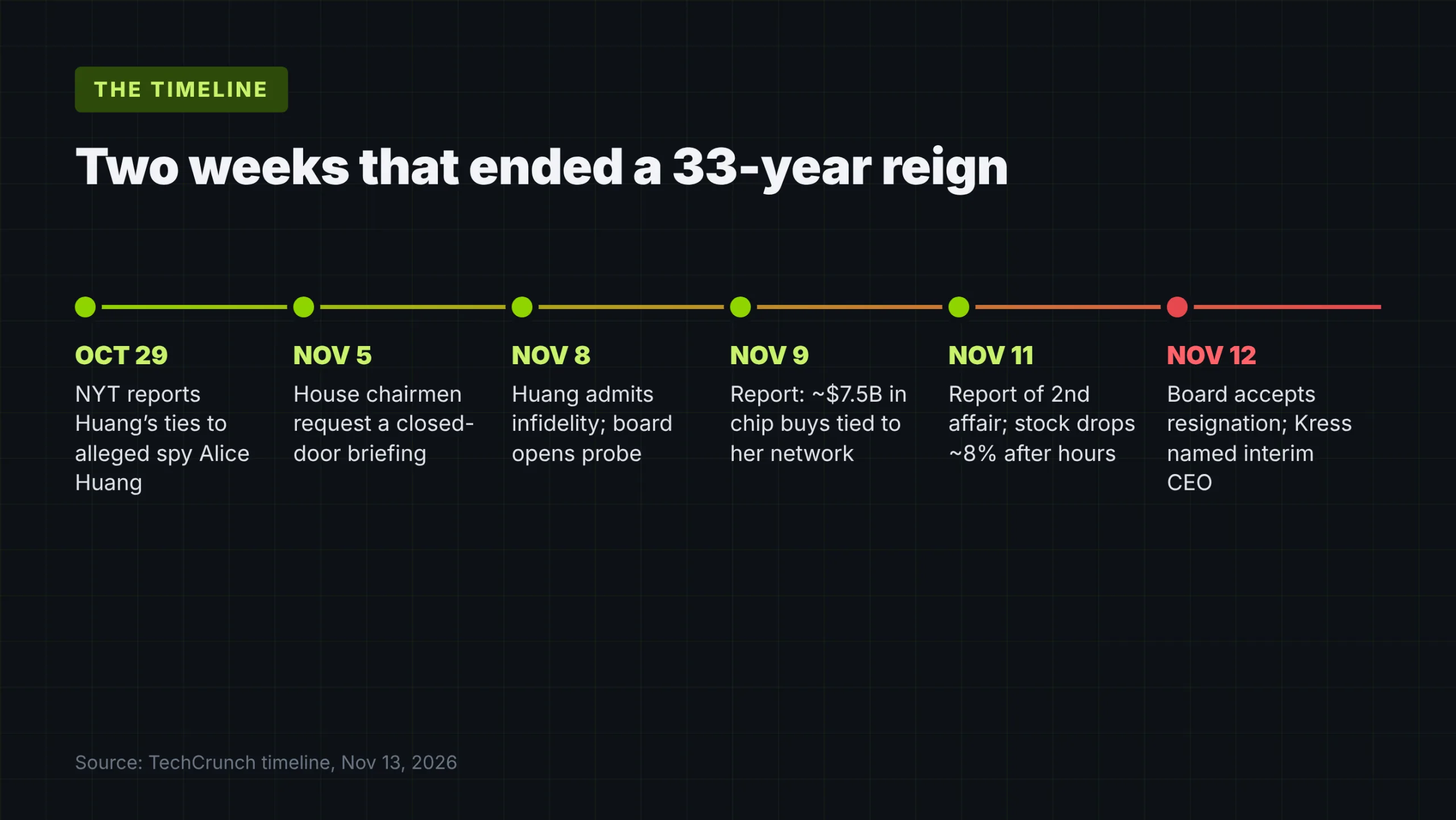
Two weeks that ended a 33-year reign
- Oct 29: The New York Times reports the close relationship between Jensen Huang and Alice Huang.
- Nov 5: Three House committee chairmen, John Moolenaar, Brian Mast and Rick Crawford, ask Huang for a closed-door briefing on his ties to Chinese intelligence.
- Nov 8: Huang admits in a letter to employees that he was unfaithful to his wife of 40 years. Nvidia's board opens an independent investigation. President Trump calls Huang "a fine person" and says he should stay.
- Nov 9: Huang pulls out of scheduled speaking events. The Information reports that Alice Huang's family network helped arrange about $7.5 billion in Nvidia chip purchases, including banned chips.
- Nov 11: The Times reports a second affair, with Kimberly Powell, an Nvidia vice president who reported directly to Huang. Nvidia, Huang and Powell did not confirm it. The stock drops about 8% after hours.
- Nov 12: The board accepts Huang's resignation. Reuters reports a third relationship, with an unnamed employee. Huang agrees to testify before Congress before Thanksgiving.
All of these dates come from TechCrunch's timeline of the scandal.
Was Jensen Huang actually a spy risk?
This is the question everyone is asking, and the honest answer is: nobody knows yet.
Here is what has not happened. Jensen Huang has not been charged with any crime. No charges against Alice Huang have been reported. Nvidia says it has "no reason to believe" national security or company secrets were compromised, reports the Boston Globe.
China's Foreign Ministry called the "so-called Chinese spy narrative" unsubstantiated and "nothing but smears against China." Alice Huang has not responded publicly, and her whereabouts are unknown.
But the timing is what worries Washington. In December 2025, Trump allowed Nvidia to sell its powerful H200 chip to China, a major easing of export rules. The H200 is roughly six times more powerful than the H20, the model China could buy before. Huang had pushed hard for those sales. If an alleged intelligence officer was close to the man lobbying for them, lawmakers want to know what she learned, and whether it shaped U.S. policy.
That is why Huang now faces questions from both parties. Senator Tim Scott has asked him and Commerce Secretary Howard Lutnick to testify before the Senate Banking Committee. Democrats Richard Neal and Ron Wyden have opened their own investigation. As Representative Brian Mast put it, Huang "has some very serious questions to answer."
What Wall Street did
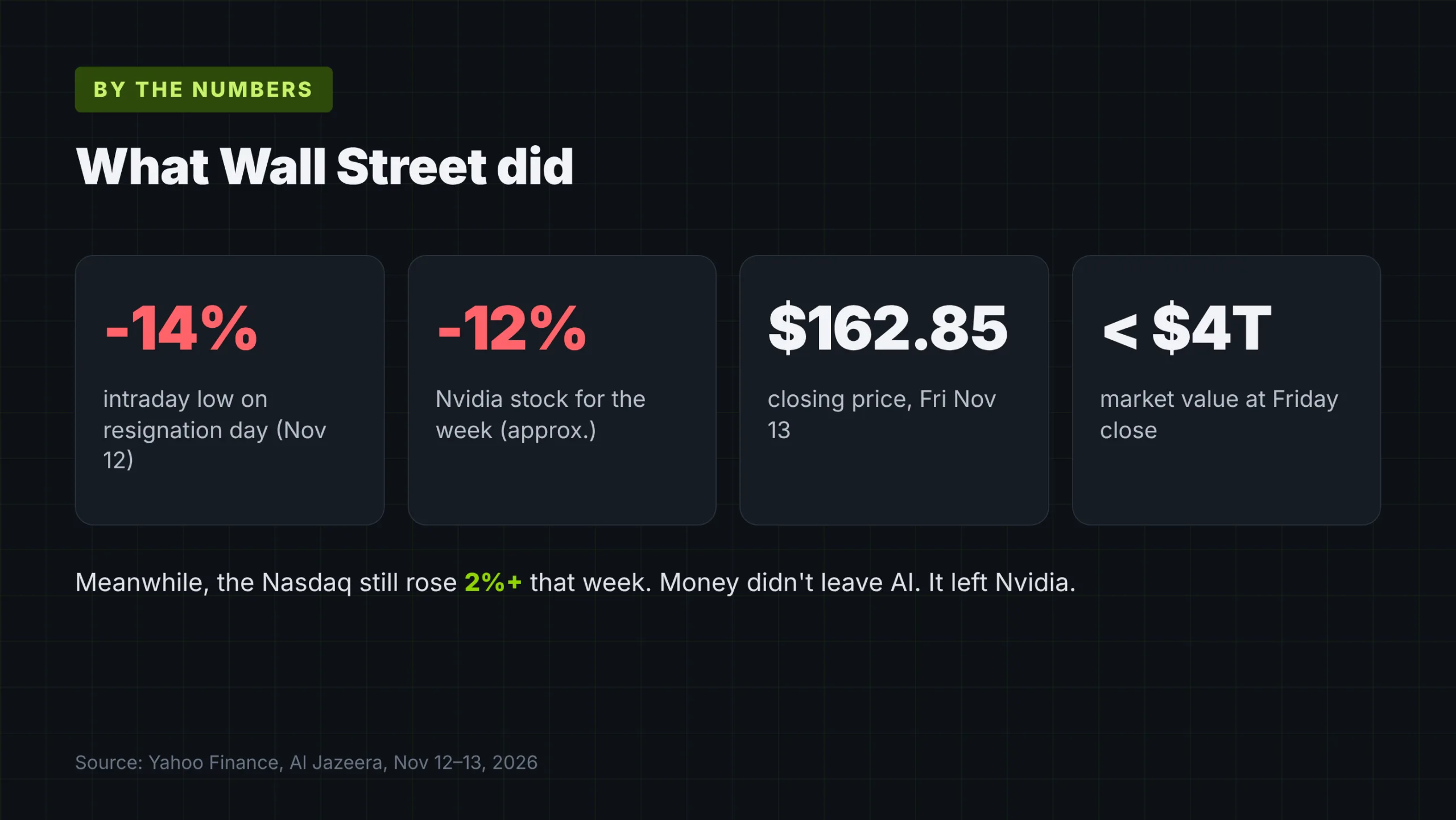
Investors did not wait for answers.
Nvidia's stock was already under pressure. On November 5, a broad selloff in AI chip stocks pushed the Nasdaq into a correction, and Nvidia fell more than 9% that day, CNN reported. That drop came before the resignation, driven by worries about AI spending.
Then the scandal hit. On the day Huang resigned, Nvidia shares fell as much as 14% at the open before closing down about 4%. On Friday, November 13, the stock closed at $162.85, down roughly 12% for the week, and Nvidia's market value slipped below $4 trillion, according to Yahoo Finance.
Interestingly, the wider Nasdaq still gained more than 2% that week. Money did not leave AI. It just moved away from Nvidia.
Who is running Nvidia now?
Nvidia's chief financial officer, Colette Kress, is now interim CEO. She has been CFO since 2013. During her time in that job, Nvidia's yearly revenue grew from $4.13 billion in fiscal 2014 to $215.9 billion in fiscal 2026, per Al Jazeera. Before Nvidia, she held finance roles at Texas Instruments, Microsoft and Cisco.
The board also named its first-ever chairman, Harvey C. Jones, and says it is looking at "internal and external candidates" for the permanent job.
There is one awkward detail. The Wall Street Journal reported on November 13 that Huang had been critical of Kress and did not express confidence in her as his successor.
Trump wants Tim Cook. Will he come?
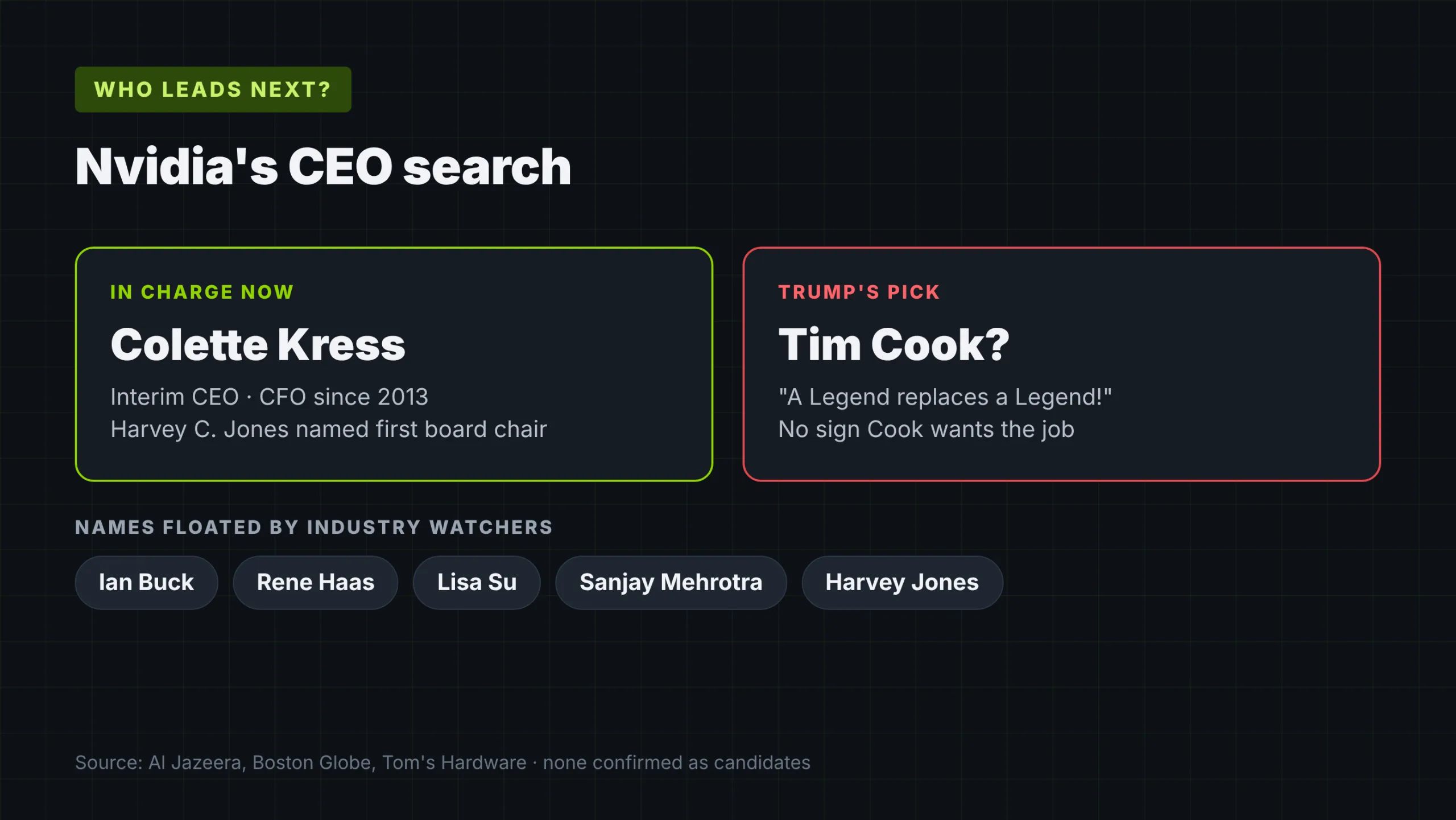
The most surprising twist came from the White House. On Truth Social, President Trump wrote that "there is only one man to take his place - TIM COOK of Apple," calling it "A Legend replaces a Legend!" Tom's Hardware reported.
Cook ran Apple from 2011 to 2026 and is now Apple's executive chair. There is no sign he wants the job.
Other names industry watchers have floated include Kress herself, longtime Nvidia executive Ian Buck, Arm CEO Rene Haas, AMD CEO Lisa Su, and Micron CEO Sanjay Mehrotra, according to Al Jazeera. None has been confirmed as a candidate.
So what happens to the company that runs AI?
Nvidia's high-end chips are the main building blocks of modern AI. Most of the chatbots, image generators and AI assistants you use were built on them. So a crisis at Nvidia is not just a business story. It touches everyone.
Here are the three things to watch next.
1. The congressional testimony. Huang has agreed to testify before Thanksgiving. If he reveals new details about what Alice Huang knew, expect pressure to tighten chip exports to China again. That would hit Nvidia's sales directly.
2. The CEO pick. An insider like Kress signals "business as usual." An outsider signals a reset. Either way, the next CEO inherits a company that was built around one founder's vision for three decades.
3. The customers. Nvidia's chips are hard to replace in the short term. Its biggest buyers, from Microsoft to Meta, cannot switch overnight. That gives Nvidia time. But rivals like AMD now have the best sales pitch they have had in years: "We're the stable choice."
The bottom line: Nvidia's technology did not change this week. Its chips are just as fast as they were on November 1. What changed is the man in charge, and the trust around him. The company still has its products. The open question is whether it can keep its customers' confidence, and Washington's, while the investigations play out.
If you found this useful, follow for clear, no-hype explainers on the biggest stories in tech and AI.